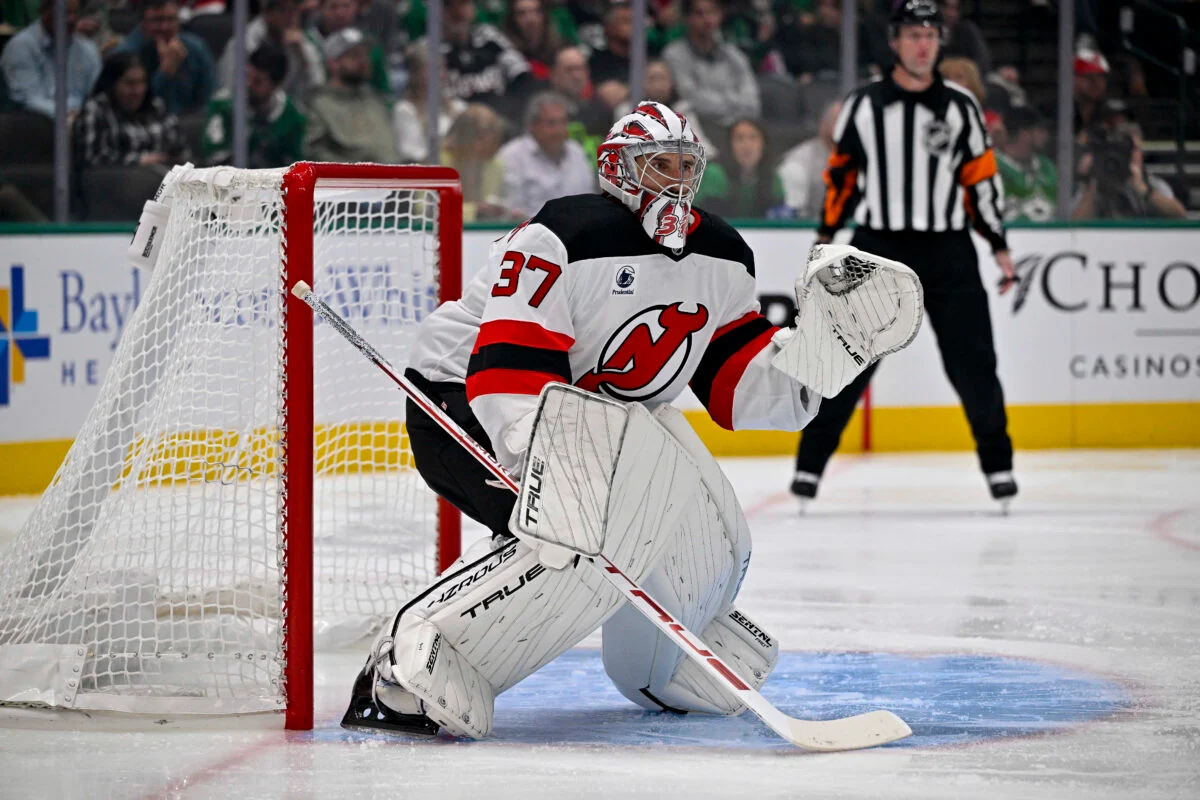
Connor Hellebuyck needed just one night to show Devils’ management what they traded for. He showed no signs of rust in his first start on Tuesday, stopping 17 of 18 shots in a 5-1 win in Dallas, a .944 save percentage that saved roughly 0.9 goals above league average. By Game AB, his 0.162 was the best goaltending performance of the night on either side, while Casey DeSmith allowed five goals on 27 shots at the other end. In front of him, Luke Hughes (0.134), Nico Hischier (0.128), and Jack Hughes (0.125) led a Devils group with 17 of 18 skaters at or above zero.

The win came four days after one of the season’s most anticipated trades. On October 23rd, the Winnipeg Jets sent Connor Hellebuyck to New Jersey for forward Dawson Mercer, goaltender Nico Daws, forward Nick Bjugstad, the rights to 2026 first-round pick Alexander Command, a 2029 second-round pick, and a 2027 seventh-round pick. Hellebuyck, 33, has five seasons left on his contract and carries an $8.5 million cap hit. The deal ended a standoff that began when he asked to be moved, continued through a suspension for failing to report to training camp, and stretched well into the regular season.
This article breaks down what each team received using AB and introduces the updated AB goalie metric that every goaltending number in this piece is built on.
An Improved AB Goalie Metric
Long before the Jupyter notebooks, the live player cards, and the AI-assisted tools that now power this site, AB started as a set of spreadsheets built during graduate work at Seton Hall. The goaltending side of the system, BractoG, was part of that original framework, laid out in Beyond Traditional Metrics: The Advanced Bracton Score Paradigm for Informed Organizational Decision-Making in Hockey back in 2023. The goalie formula from those sheets is the foundation of what is now called Goalie AB, or GAB, and I’ve rebuilt it to run automatically for every season since 2007-2008 and every game this season.
The formula is:
GAB = (NET GAA x GS + Net Sv% x GS + NET NET + Team AB x GS / Team GP) / 20
Each piece measures something different.
NET GAA x GS rewards a goalie for keeping his goals-against average below the league average, scaled by how many games he started. A goalie who beats the league GAA by half a goal over 60 starts earns far more than one who does it in 15.
Net Sv% x GS does the same for save percentage, comparing his save percentage to the league average and scaling it by starts.
NET NET measures shot volume and goals allowed together. It takes the shots a goalie faced, converts them into the goals an average goalie would be expected to allow at that volume, and subtracts the goals he actually allowed. It then compares that number to the league average, so a goalie who faces heavy volume and keeps the puck out of the net is rewarded for both.
Team AB x GS / Team GP connects the goalie to the skaters in front of him. It takes the summed AB Score of his team’s skaters and credits the goalie with his share based on the percentage of games he started. Goaltending and team defense aren’t separable, and this ensures a goalie’s number reflects the team he plays behind.
We divide the total by 20 to keep GAB on a scale comparable to skater AB. Every league average is calculated within one league and one season, so a goalie is always measured against his own peers.
The update also made the metric universal. Every input- starts or minutes played, shots against, saves, goals against, and team skater AB- is available for the NHL and every other league in the AB database through InStat. That means the same formula can evaluate a goalie in the NHL, the AHL, the SHL, or the WHL on the same terms, something the original spreadsheets couldn’t do at scale. I will work to add these goaltending formulas to the other leagues in the study as soon as possible. That said, the rebuilt version tracks the original BractoG sheets closely (0.94 correlation), and adding GAB to team skater AB improves how well AB tracks the NHL standings, from an average rank correlation of 0.855 with skaters alone to 0.867 with goaltending included.
GAB also runs game by game. For a single game, starts are replaced with minutes played divided by 60, league rates are calculated per 60 minutes, and the Team AB share uses each team’s live 2026-2027 skater AB, paced to a full 84-game season. Over the whole season, a goalie’s game-by-game numbers add up to very nearly his season GAB, but the two will not match exactly in small samples. The season version compares NET NET against the average goalie season and credits Team AB based on a team’s starts to date, while the game version compares each night against league per-60 rates. Early in the year, with only a handful of starts, those differences are noticeable. That is why Hellebuyck’s season-formula number for his single start reads slightly differently from his 0.162 Game GAB, and why Daws’ four starts show up as +0.54 on one card and +0.010 on another. As the sample grows, the two converge.
New Jersey’s Side and Outlook

Hellebuyck’s resume needs little introduction. A fifth-round pick by Winnipeg in 2012, he won the Vezina Trophy in 2020, 2024, and 2025, and in 2025 became the first goaltender since Carey Price in 2015 to win the Hart Trophy as league MVP. He led the NHL with 47 wins in 2024-2025 with a 2.00 GAA and a .925 save percentage, and the Jets won the Jennings Trophy in 2024 for allowing the fewest goals in the league. In February, he made 41 saves in a 2-1 overtime win over Canada to give the United States its first Olympic gold medal in men’s hockey since 1980. Across 616 career games, he is 346-208-55 with a .916 save percentage.
GAB tells the same story. Hellebuyck ranked first in the league in 2017-2018 (4.94), 2019-2020 (3.61), 2023-2024 (5.04), and 2024-2025 (6.22), and fourth in 2022-2023 (5.13). His 2024-2025 season is one of the highest single-season GAB marks in the database. His career GAB of 32.7 ranks third among 239 goalies since 2007.
The one “down year” is last season. In 2025-2026, Hellebuyck posted a 2.86 GAA and an .895 save percentage across 57 starts, and his GAB fell to 1.14, 28th in the league. Some of that falls on Winnipeg’s skaters, which is where this trade’s opportunity comes in.

Using the goalie version of the Opportunity Projector, AB projects what Hellebuyck would produce in each situation over 58 starts this season. Winnipeg’s live 2026-2027 skater AB sits at 16.7, 12.2 below the league average. New Jersey’s sits at 36.9, 8.0 above it. That gap shows up in two places. Facing fewer, easier chances with the Devils improves his GAA, save percentage, and NET NET by an estimated 1.29 GAB, and the Team AB share adds another 0.70. The result is a projection of +2.55 GAB with New Jersey, compared to +0.57 had he remained in Winnipeg, with a likely range of +1.20 to +3.90. Season-to-season goaltending is volatile, so that range matters, but the direction is clear. Hellebuyck now plays in front of one of the better skater groups in the league.
The contract adds to the value. His $8.5 million cap hit takes 8.2% of this season’s $104 million cap and 7.5% of the $113 million cap next season. AB projects his value at $10.37 million, 9.17% of the 2027-2028 cap, meaning New Jersey is receiving surplus value on the deal. His career comparables, Andrei Vasilevskiy, Tuukka Rask, and Marc-Andre Fleury, are the goalies who defined their eras. The risk is age. Hellebuyck is 33, and the five remaining years of the contract will carry him through his age-37 season, so the back half of the deal is where the uncertainty lives
The Devils’ roster explains why the projection is so favorable. Through 12 games, Jack Hughes leads the team with a +5.18 84-game pace, and Luke Evangelista (+4.01), Arseny Gritsyuk (+3.87), Jesper Bratt (+3.80), and Nico Hischier (+3.54) all sit well above the +0.35 forward replacement level. On the back end, Brett Pesce (+2.82), Dougie Hamilton (+2.27), and Luke Hughes (+2.15) lead the defense.

Prior to the trade, the Devils’ goaltending was the weakest of their three position groups. New Jersey ranks eighth in forward AB above replacement and ninth on defense, but 15th in goaltending, right at league average. Jake Allen had carried the load with a .886 save percentage across seven games, and the team’s .876 save percentage ranked near the bottom of the league when the deal was made. Acquiring Hellebuyck is a commitment to the position, both now and for the next five seasons.
Winnipeg’s Side and Outlook

Dawson Mercer is Winnipeg’s centerpiece, and he has been one of the more consistent scorers in New Jersey since entering the league. After a 17-goal rookie season, he scored 27 goals in 2022-2023, then 20, 19, and 20 in each of the last three seasons, giving him 103 career goals. His AB Score peaked at 2.97 in 2022-2023 and has climbed in each of the last two seasons, from 1.06 to 1.67 to 1.85, all above the 1.14 replacement level. AB projects his next contract at $6.50 million, 5.75% of the 2027-2028 cap. Mercer is in the final season of a deal carrying a $4.0 million cap hit and will be a restricted free agent with arbitration rights next summer, so a raise is coming. His career comparables, Jordan Staal, Trevor Zegras, and Dylan Cozens, describe a significantly above-average middle-six forward, still with top-six potential.

His start to the season has been slower. Through 12 games, ten with New Jersey and two with Winnipeg, Mercer has four assists and no goals, with a +0.86 84-game pace that still sits above replacement.

His role in Winnipeg is also different. Mercer has slotted onto the third line alongside Adam Lowry and Viggo Bjork, and at roughly 15 minutes a night, the Opportunity Projector estimates his AB at +0.81 over a full season, compared to +1.53 had he stayed in his New Jersey role. Nearly all of that gap, 0.53 of the 0.72 difference, comes from losing about three minutes of ice time from the 18.1 he averaged with the Devils last season. If his minutes climb, so will his production.

Nico Daws gives Winnipeg a third goaltender, but the numbers suggest he is not an upgrade on the depth the Jets already have. Daws has never posted a positive GAB season, at -0.81 in 2021-2022, -0.64 in 2023-2024, and -0.09 in 2025-2026, and his career GAB of -1.5 ranks 183rd of 239 goalies since 2007. He opened this season 2-2-0 with an .872 save percentage and 1.8 goals saved below average across four games with New Jersey.


The Opportunity Projector does not see the move to Winnipeg helping him, either. Behind the Jets’ skaters, his projection falls slightly, from +0.08 to -0.02.

Stuart Skinner has been Winnipeg’s best goalie this season, with a .911 save percentage and a +4.60 84-game pace across eight games. Daws’ .872 save percentage and +0.21 pace do not compare, and neither does his track record. Skinner is the better goalie, and the numbers show it.

Nick Bjugstad is primarily a cap piece. He posted nine points and a 0.07 AB Score last season, carries a $1.75 million cap hit in the final year of his contract, and is currently on long-term injured reserve.

Alexander Command is the long-term piece of the return. New Jersey selected the 6’1″, 183-pound center 12th overall in June, ahead of where most public rankings had him. Most outlets projected him somewhere between 20th and 32nd, with Craig Button at 16th and NHL Central Scouting ranking him 12th among European skaters. Winnipeg was familiar with him. Jets general manager Kevin Cheveldayoff told CBC News that the organization did a lot of work on Command before the draft, before ultimately selecting Viggo Björck instead. Command spent his draft year with Örebro’s J20 team, where he led the club in scoring as a 17-year-old, posting 56 points and a 2.22 AB Score in 44 games.
That 2.22 is more than three times the J20 replacement level of 0.62, and once the J20 league deflator is applied, it works out to +0.96 NHL-equivalent AB. That sits just below the 1.14 replacement level for NHL forwards, a solid mark for a player who turned 18 in June. For context, Mercer’s NHL-equivalent mark in his own draft year in the QMJHL was 0.91, so Command arrives in Winnipeg at roughly the level Mercer was at when New Jersey drafted him 18th overall in 2020. He is likely a few seasons away from the NHL, but Winnipeg now has both of the young forwards it evaluated closely in June.

Winnipeg’s outlook is the most difficult part of this trade. With Mercer and Daws now counted for Winnipeg, the Jets rank 28th in forward AB above replacement, 27th on defense, 14th in goaltending, and 26th overall. Kyle Connor (+3.92 pace) is the only forward producing at a top-line rate, and the group in front of the net is among the league’s weakest. For Winnipeg, this trade is less about this season and more about the next several.
Why This Trade Makes Sense for Both Sides
For New Jersey, the logic is straightforward. The Devils built a roster to win now: a skater group that ranks among the league’s best and roughly league-average goaltending. They addressed that weakness with one of the best goalies of the last decade, on a contract that AB values above its cost, without giving up a first-round pick or any of their core young players.
For Winnipeg, moving on has real value. A player who asked to leave, was suspended, and spent the early part of the season away from the team wasn’t going to return to the room without lingering tension. Resolving the situation removes that distraction and allows the Jets to focus on the players who are there. Mercer gives them a proven 20-goal scorer, Command gives them a first-round prospect, and the picks add to their future.
That said, it is fair to question the timing. Winnipeg reportedly explored a deal with Buffalo in June that included a swap of first-round picks, with the Sabres holding fourth overall and the Jets eighth. That deal fell through, and the longer the standoff continued, the more Winnipeg’s leverage declined. The Jets’ return is reasonable, but it is likely not as strong as what was available in the summer, before the holdout and suspension made the outcome inevitable. Letting the situation drag into the regular season probably cost them something.
Ultimately, the trade reflects two teams at very different points. New Jersey paid for proven production and made a long-term commitment to a key position in the sport. Winnipeg turned a situation it could no longer control into assets that fit a rebuild. Both outcomes are defensible, but in the short term, the Devils got the best player in the deal and one of the best goaltenders this league has ever seen.
What Comes Next
The trade could also shape New Jersey’s next moves. Quinn Hughes can become a free agent in July 2027, and the chance to play alongside both of his brothers in front of a Vezina-winning goalie (and Team USA teammate) certainly makes New Jersey an even more attractive destination, a situation broken down in The Quinn Hughes Situation: Why the Wild Are in a Better Position Than It Seems. Dylan Larkin’s trade request in Detroit, examined in The Detroit Red Wings Aren’t a Disaster: Why It’s Time for the Organization to Pick a Direction, is another situation worth watching, as he recently added the Devils to his trade list. Whether New Jersey pursues one, both, or neither, adding Hellebuyck signals that the team intends to contend now.
Leave a Reply