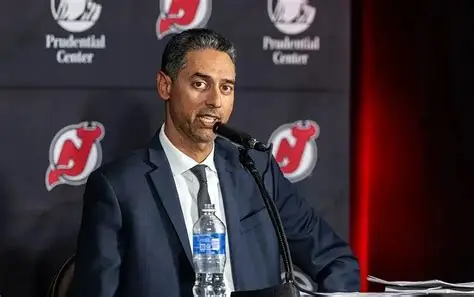
When Sunny Mehta was introduced as General Manager of the New Jersey Devils in April, he inherited a team coming off a 42-37-3, 87-point season that finished 12 points out of the final Eastern Conference playoff spot. The Devils averaged just 2.76 goals per game in 2025-2026, the sixth-fewest in the NHL, and the roster was top-heavy, with elite talent at the top and far too much replacement-level production underneath it. Five months later, the Devils enter the 2026-2027 season with their captain locked up, a reshaped forward group, and a proven head coach behind the bench.
Mehta’s first offseason was busy. He extended Nico Hischier and Arseny Gritsyuk, signed Anthony Mantha, Evan Rodrigues, and Jesper Boqvist in free agency, traded Simon Nemec to Calgary and flipped part of that return into Luke Evangelista, moved off the Jacob Markstrom contract, and drafted Alexander Command 12th overall. Every one of those decisions can be measured through AB, and together they paint a picture of an organization that is significantly better positioned than it was in April. According to the AB projections, the Devils are a playoff team in 2026-2027, projected to finish third in the Metropolitan Division, with a fuller breakdown coming in hockeyfreeforall.com’s upcoming preseason predictions.
The Extensions: Hischier and Gritsyuk
The most important piece of business Mehta faced was his captain’s future, and he handled it on the first possible day. On July 1st, the Devils signed Nico Hischier to a five-year, $58.5 million extension carrying an $11.7 million AAV, beginning in 2027-2028 and running through 2031-2032. The deal includes a full no-movement clause, followed by modified no-trade lists in the final two seasons.

Hischier remains one of the most consistent two-way centers in the league. He led the Devils with 28 goals in 2025-2026 while appearing in all 82 games, and led the entire NHL in faceoff wins. His 66 points and 2.94 AB Score continued a remarkable run of stability. Since 2021-2022, his AB Score has never dropped below 2.8, peaking at 4.53 in 2022-2023. Across his career, he has 488 points in 609 games (0.80 PPG).
The model projects Hischier’s current market value at $10.52 million, 10.11% of this season’s $104 million cap. His extension took 11.25% of the cap when it was signed, a small premium of just over one percentage point. However, that premium disappears almost immediately. When the deal kicks in next season, $11.7 million will represent just 10.3% of the $113.5 million cap, nearly identical to Hischier’s projected share. If the cap reaches the projected $127.5 million in 2028-2029, the contract will take only 9.2% of it, meaning Hischier’s projected value will exceed his cap hit for the majority of the deal. This contract will age beautifully.
His comparables confirm it. Among his career comparables, Roope Hintz signed at 10.2% of the cap, while Jack Hughes and Robert Thomas each signed at 9.8%. Hischier’s deal sits right in line with the league’s top two-way centers once the rising cap is accounted for, and well below the 13% to 17% range that younger, less proven centers were signing for this summer.
For context, Hischier’s original seven-year, $50.75 million contract took 8.9% of the $81.5 million cap when it was signed and has since shrunk to 6.97% entering its final season. The Devils enjoyed years of surplus value on that deal, and his new one is structured to deliver the same.

The Gritsyuk extension is another example of disciplined cap management. The Devils re-signed the 25-year-old winger to a three-year, $9.75 million contract, a $3.25 million AAV that took 3.13% of the cap. In his first NHL season, Gritsyuk posted 31 points and a 1.28 AB Score, clearing the replacement threshold as a rookie. The model projects him at $3.65 million, 3.51% of the cap, making his deal a slight bargain. His 2025-2026 comparables, Zachary Bolduc (1.33 AB) and Mackie Samoskevich (1.55 AB), signed at 4.0% and 3.7% of the cap, respectively, both above Gritsyuk’s share. In a summer where the market paid defensemen with below-replacement AB Scores over 7% of the cap, locking in an above-replacement forward at just over 3% is more than fair. He is also viewed as a strong play driver, and he has been paired with Dawson Mercer in camp, a combination that could give the Devils a legitimate third line.
The Mantha Signing

Anthony Mantha was the Devils’ most notable free agent addition. He signed a two-year, $9.5 million deal with a $4.75 million AAV after scoring 33 goals and 64 points with the Pittsburgh Penguins, which translated into a 3.04 AB Score, the best of his career and the third-highest mark on the 2026-2027 Devils.
The model is cautious on Mantha, projecting his value at $2.97 million, 2.86% of the cap, compared to the 4.57% the Devils committed. That gap stems from his age (32) and the volatility in his trajectory. Mantha’s AB Score has swung sharply throughout his career, from 2.08 in 2018-2019 to 1.04 in 2021-2022, and from 2.22 in 2023-2024 to just 0.30 in an injury-shortened 2024-2025 before his rebound last season. His career comparables, Brendan Gallagher and Ilya Mikheyev, signed at 8.0% and 3.7% of the cap, respectively, which shows how wide the range of outcomes is for players with his profile.
However, the structure of the deal is where Mehta deserves credit. Two years limits the long-term risk, and even if the model is right about the $1.78 million gap, it is a short-term premium on a player who fills an immediate need. Mantha has opened camp on the top line with Jack Hughes and Jesper Bratt, and his size at 6’5″ and 234 pounds, combined with his ability to score off the rush, adds a dimension the Devils lacked in 2025-2026. For a team that ranked in the bottom six in goals per game, a 33-goal scorer on a two-year deal is a calculated bet, not a long-term liability.
The Nemec and Evangelista Trades
Mehta’s two biggest trades should be viewed together, as the second was made possible by the first. On June 23rd, the Devils traded Simon Nemec and Maxim Tsyplakov to Calgary for conditional first-round picks in 2027 and 2028, a 2026 second-round pick, and defenseman prospect Etienne Morin. Mehta said the return was too good to pass up.

The data backs him up. Nemec’s AB Score has never cleared the 1.14 replacement level, falling from 0.67 in 2023-2024 to -0.20 in 2024-2025 before partially rebounding to 0.83 last season. Calgary then signed him to a five-year, $36.25 million deal, a $7.25 million AAV that took 7.0% of the cap. AB projects him at $3.26 million, just 3.14% of the cap. His comparables, Mason Lohrei (3.4%) and Nils Lundkvist (1.8%), signed for a fraction of that share. Had Mehta kept Nemec and signed him to a comparable deal, New Jersey would have been paying roughly $4 million per season above market value. Tsyplakov, whose $2.25 million deal was one of several below-replacement contracts identified in hockeyfreeforall.com’s May analysis of the Devils, went with him.
Two months later, Mehta turned part of that return into a top-six forward. On September 1st, the Devils acquired Luke Evangelista from Nashville for Colorado’s conditional 2028 first-round pick, the same pick acquired from Calgary, along with New Jersey’s own 2028 second-round pick. On September 15th, Evangelista signed a five-year extension with a $7.25 million AAV that begins in 2027-2028.

Evangelista’s 2025-2026 season was a breakout. The 24-year-old posted 12 goals, 44 assists, and 56 points in 81 games, good for a 2.70 AB Score, the fifth-highest on the 2026-2027 Devils. He ranked in the 93rd percentile among forwards in even-strength offense and the 92nd in even-strength defense. Nashville’s three best lines by expected goals percentage all featured him.
Hockeyfreeforall.com’s June analysis of the Nashville Predators identified Evangelista as one of the most encouraging developments of the 2025-2026 season and a building block for the Predators’ next era. That piece noted that his 2.70 AB Score came with a model projection more than double his $3 million cap hit, driven by more than three minutes of ice time per game and 24 additional points from 2024-2025 to 2025-2026. Nashville ultimately chose a different direction, and New Jersey benefited.
The model values his extension fairly. AB projects Evangelista at $7.03 million, 6.76% of the cap, while his $7.25 million deal took 6.97% of the cap at signing and will take just 6.4% of the 2027-2028 cap when it begins. His comparables line up almost perfectly. Troy Terry (2.84 AB) signed at 8.4% of the cap, Quinton Byfield at 7.1%, and Jackson Blake (2.45 AB) at 5.4%. For this season, the Devils get a 2.70 AB winger at $3 million, a surplus of over $4 million, the largest single-player surplus on the roster.
Combined, the two trades make the math striking. The Devils moved on from a below-replacement defenseman, a below-replacement forward, and their own 2028 second-round pick. In exchange, they landed a 24-year-old top-six winger coming off a 2.70 AB season and locked up through his prime, a conditional 2027 first-round pick, a 2026 second-round pick, and a defense prospect. It is the type of asset management that separates good front offices from great ones.
Alexander Command

Mehta’s first draft pick as Devils GM was Alexander Command, selected 12th overall out of Örebro’s U20 program in Sweden. The 18-year-old center posted 56 points in 44 games (1.27 PPG) and a 2.22 AB Score in the J20 league, well above the league’s replacement average of 0.62. Adjusted for league quality, his NHL-equivalent AB sits at +0.96, and his prospect comparables, including Viggo Bjorck, Liam Ruck, and Benjamin Kindel, project him as a first-round talent, averaging a draft position of Round 1.20. Command, along with the acquisition of Amadeus Lombardi, gives the Devils a center pipeline behind Hughes and Hischier that didn’t exist a year ago.
Keeping Sheldon Keefe
One of the first questions Mehta faced was whether to make a coaching change after a disappointing season. In May, hockeyfreeforall.com’s analysis of Mehta’s offseason checklist argued against it, as the AB Coaches study ranked Keefe among the top quintile of coaches since 2007 and seventh among active head coaches. The data suggested that the Devils’ issues lay in the bottom six and the bottom defensive pairings rather than behind the bench, and that the only clear upgrade on the market was Bruce Cassidy. Mehta kept Keefe, and the updated data supports that decision.

Keefe now ranks 14th in the study with a Coaching AB of 0.5632 and a 91.9 confidence rating, with Joel Quenneville as his closest comparable. His Coaching AB sits well above the study average of 0.472 and just below the Top 10 average of 0.611. His strongest area remains player performance. The average AB Score of a Keefe player is 1.277, far above the study average of 0.961, and he outperforms the study average in Advantage % (51.5% to 49.1%), Average Range Score (0.749 to 0.392), and Average Player AB. His key players over his career, Auston Matthews (4.795), Mitch Marner (4.267), Jesper Bratt (3.613), William Nylander (3.540), and Jack Hughes (3.529), show his ability to get the most out of elite talent.
That is exactly the type of coach this roster needs. With Mehta’s offseason additions filling the holes identified in May, Keefe now has a deeper forward group to work with, and the data suggests he is well equipped to maximize it.
Roster Construction for 2026-2027

The graph above illustrates the Devils’ projected 2026-2027 roster by individual AB Score. The top of the lineup is significantly stronger than a year ago. Five players now sit above 2.70: Jack Hughes (3.55), Jesper Bratt (3.06), Anthony Mantha (3.04), Nico Hischier (2.94), and Luke Evangelista (2.70). Two of those five were added this summer. In total, 11 players clear the 1.17 league replacement level, with Connor Brown (1.92), Dawson Mercer (1.85), Timo Meier (1.72), Dougie Hamilton (1.37), Luke Hughes (1.34), and Cody Glass (1.23) rounding out that group, while Evan Rodrigues sits just below the line at 1.15.
The forward group is now deep enough that the Devils no longer need to rely on players like Mercer and Brown to fill top-six roles. With Mantha on the top line alongside Hughes and Bratt and Evangelista paired with Meier and Hischier, New Jersey has two scoring lines capable of driving play, and a third line built around Gritsyuk and Mercer that can contribute offensively as well.
The defense remains the area of concern. Only Hamilton and Luke Hughes clear the replacement threshold, while Jonas Siegenthaler (0.31), Brett Pesce (0.18), Brenden Dillon (0.12), and Johnathan Kovacevic (0.10) all sit well below it. That group holds the Devils’ remaining upside, whether through prospect development, a midseason trade, or improved play under Keefe.

The salary graph tells a similar story. The core is delivering tremendous value. Luke Hughes ($9.00 million against a $11.62 million projection), Jack Hughes ($8.00 million against $11.50 million), Jesper Bratt ($7.88 million against $11.14 million), Nico Hischier ($7.25 million against $10.52 million), and Luke Evangelista ($3.00 million against $7.03 million) combine for roughly $16.7 million in surplus value this season. Including smaller surpluses on players like Mercer, Brown, and Glass, the roster generates about $21.7 million in total surplus.
The overpayments are concentrated in a few places. Dougie Hamilton ($9.00 million against a $5.68 million projection), Brett Pesce ($5.50 million against $2.95 million), and Timo Meier ($8.80 million against $6.75 million) account for most of the roughly $14.3 million in total overpayment, with Mantha, Kovacevic, and Dillon making up much of the rest. Netting those numbers out, the Devils’ roster generates roughly $7.4 million more in on-ice value than it costs, a healthy position for any team with playoff aspirations. The Dillon, Noesen, and Bjugstad contracts all expire after this season, which will give Mehta even more flexibility next summer to address the defense.
Conclusion
Sunny Mehta’s first offseason as General Manager of the New Jersey Devils was a success by nearly every measure. He locked up his captain on a contract that will age well as the cap rises, re-signed a young forward below market value, added two legitimate top-six wingers, turned a below-replacement defenseman into a surplus of assets, kept a proven head coach, and drafted a promising center prospect. The Devils entered the summer needing to raise their roster floor without disrupting their core, and that is exactly what Mehta did.
Questions remain on the blue line, and the rest of the Metropolitan Division won’t make anything easy. However, with elite talent at the top of the lineup, a deeper supporting cast, and roughly $7.4 million in net surplus value, the Devils are well positioned to return to the playoffs in 2026-2027 and to remain competitive well beyond it.
Leave a Reply