This summer, the NHL’s contract market didn’t evolve so much as detonate. Five years ago, a $10 million cap hit was reserved for the league’s established superstars, players with Hart Trophy nominations and multiple 90-point seasons on their resume. Today, 21-year-olds with three NHL seasons and zero playoff series of consequence are signing for $13.75, $15, and $18 million annually. Defensemen with fewer than 160 career games and below-replacement AB Scores are landing deals worth over $7 million per season. Every hockey front office now has to answer whether this is a temporary overcorrection or the new standard for how young talent gets paid.
The answer is probably both. The world is changing, and teams that refuse to accept that will lose their best young players. However, the rising cap doesn’t make these numbers insignificant, and the data suggests several of this summer’s biggest contracts pay players for what they might become rather than what they’ve actually done. The cards throughout this article illustrate exactly where AB sees the gap between projected market value and actual contract, and in several cases, that gap is enormous.
The Offer Sheet That Changed Everything
Any conversation about this summer’s market has to start with Leo Carlsson. On July 3rd, the Philadelphia Flyers extended a five-year offer sheet worth an average annual value of $18 million, running from 2026-2027 through 2030-2031, and Anaheim matched it. The deal made the 21-year-old Carlsson the highest-paid player in the NHL. Had the Ducks declined to match, they would have received four first-round draft picks from the Flyers as compensation, which tells you exactly how seriously Philadelphia was willing to take the risk.
The deal structure was just as aggressive as the number. Of the $90 million total, $85.3 million comes in signing bonuses, with Carlsson earning a base salary of just $850,000 and a $19.95 million signing bonus in 2026-2027 alone. Contracts built like that are nearly impossible to buy out and extremely attractive to the player, which is precisely why Philadelphia built it that way. Even Anaheim’s own general manager admitted the number caught the front office off guard. Pat Verbeek said the Ducks didn’t see an offer sheet that high coming, but expressed confidence that the rising cap and Carlsson’s development would make the contract a good one in the end.

Here’s where the AB perspective matters. Carlsson posted a 3.18 AB Score in 2025-2026, a legitimate jump from 2.17 the year prior and well above the 1.14 replacement level. He is absolutely a franchise center. However, the model projects his market value at $8.94 million, or 8.6% of the $104 million cap. His actual contract consumes 17.3%, more than double. That is a gap of roughly $9.06 million per season, or more than $45 million over the life of the deal. The fair way to judge that number is against the share of the cap his comparables took when they signed, not the dollar figures they carry today, since many of those deals were signed under a much smaller ceiling. Seth Jarvis posted a higher AB Score (3.27), and his $7.42 million deal took 8.4% of the cap when it was signed. Trevor Zegras (2.96) signed at 8.8%, and Morgan Geekie (3.06) at 5.8%. Translated to today’s $104 million cap, Jarvis’s deal would be worth roughly $8.7 million, which is almost exactly what AB projects for Carlsson. Even among his career comparables, Pierre-Luc Dubois signed at 10.2% and Anthony Cirelli at 7.6%. Carlsson’s 17.3% isn’t just high; it sits in a completely different tier from every player the model views as statistically similar. ESPN noted that Carlsson is now paid $18 million annually despite never scoring 30 goals, playing 80 games, or exceeding 67 points in a season.
The ripple effect was immediate. Carlsson’s number didn’t just set a new ceiling for young centers; it reset every negotiation happening around the league at the same time.
The Cap Is About to Explode
The only reason any of these contracts are survivable is the salary cap’s trajectory. Between 2019-2020 and 2021-2022, the cap never rose above $81.5 million, and it only increased by $1 million annually through 2023-2024. That era is over. The upper limit for this season is $104 million, up from $95.5 million in 2025-2026, and it is projected to rise to $113.5 million in 2027-2028. The bigger headline came this week, as the league reportedly shared a first estimate of $127.5 million for 2028-2029 with owners, a single-year record increase of $14 million. Commissioner Gary Bettman said revenue projections for this season sit at approximately $8.1 billion.

As the graph illustrates, the cap will have grown by roughly 56% over a nine year span if the 2028-2029 estimate holds. Under the current CBA, a player can earn a maximum of 20% of the cap, which sits at $20.8 million this season and would rise to $25.5 million under the 2028-2029 projection. Carlsson’s $18 million, which sounds absurd today, would represent just 14.1% of a $127.5 million cap. That’s the argument every agent in the league is making right now, and it’s a fair one.
However, the rising cap doesn’t erase the problem, it just delays it. Every team gets the same increase. If one club is paying its center 17% of the cap for production AB values at 8.6%, that team is still spending roughly $9 million more than its competitors for the same output, and that money has to come from somewhere else on the roster. The cap going up raises the tide for all 32 teams, not just the ones that overpaid. It’s also why raw dollar comparisons across eras are misleading. A $7 million deal signed under an $81.5 million cap took 8.6% of a team’s spending room, while the same $7 million today takes just 6.7%. Throughout this article, every comparable is measured by the percentage of the cap it consumed at signing, which is the only honest way to line up a flat cap contract next to one signed this summer.
Connor Bedard and Leo Carlsson
If there are two players in this group who are safe bets to develop into their franchise money, it’s Leo Carlsson and Connor Bedard. Bedard signed a five-year extension with a $15 million cap hit running through 2030-2031, after posting career highs of 30 goals, 45 assists, and 75 points in 69 games during 2025-2026. He has led the Blackhawks in points in each of his first three seasons, totaling 203 points in 219 games.

What’s fascinating is how the Carlsson offer sheet shaped the Bedard negotiation. Before the summer, AFP Analytics projected Bedard would earn around $12.4 million annually, roughly 11.89% of the cap, on an eight-year deal. After Carlsson hit $18 million, Chicago ended up at $15 million. AB projects Bedard’s market value at $9.93 million, 9.55% of the cap, meaning the Blackhawks are paying roughly a $5.07 million premium per season.
That said, Bedard’s deal is far more defensible than Carlsson’s. His 3.09 AB Score is essentially level with Carlsson’s 3.18, yet his career points per game (0.93) dwarfs Carlsson’s 0.70. Bedard signed at 14.4% of the cap, nearly three full percentage points below Carlsson’s 17.3%, and he did so as the more productive player. His comparables still show the premium Chicago is paying. Jack Hughes (3.55 AB) signed his $8.00 million deal at 9.8% of the cap, which would equal about $10.2 million today, while Nick Schmaltz (3.70 AB) signed at 8.4%. On a career basis, J.T. Miller signed at 9.7% and Ryan Nugent-Hopkins at 6.3%. The closest statistical peers to Bedard landed somewhere between 8% and 10% of the cap at signing, which lines up with AB’s projection of 9.55%. Chicago is paying a premium of roughly five percentage points, but it’s paying it for the player with the best track record in this article. Bedard will also miss the first month of the season after undergoing left shoulder surgery on July 8th, a reminder that $15 million commitments come with their own risk.
Macklin Celebrini: The One Contract Worth Every Dollar
If Carlsson’s deal is the clearest example of a team paying for potential, Macklin Celebrini’s is the clearest example of a team paying for production. On July 29th, San Jose signed Celebrini to a five-year, $94 million extension, and the $18.8 million AAV made the 20-year-old the highest-paid player in the NHL on a per-season basis, surpassing Carlsson just 20 days after Anaheim matched the Flyers’ offer sheet. The deal kicks in for 2027-2028 and runs through 2031-2032. The structure is almost entirely signing bonus, with Celebrini earning a $950,000 base salary and a $19.85 million signing bonus in each of the first two years, for $20.8 million in actual compensation per season early in the deal.
The difference between Celebrini and every other player in this article is that the production already justifies the number. His 2025-2026 season was one of the most dominant seasons by a teenager in NHL history. He finished with 115 points, a 5.37 AB Score, and a staggering jump from roughly 2.3 in his rookie season. He led the Sharks in goals, assists, points, power-play points, game-winning goals, and shots, and he joined Wayne Gretzky as the only players under 20 years old to record a season with 40 or more goals and 70 or more assists. San Jose went 26-3-2 when he recorded multiple points, and he factored into the winning goal in 19 of the team’s 37 wins in regulation or overtime. There is a very real argument that, by the numbers, Celebrini is already the best player in the league.

This is where the cap percentage matters most. Celebrini signed his deal under this season’s $104 million cap, so his $18.8 million took 18.1% of the cap at signing. When it kicks in next season, it will take 16.6% of the $113.5 million cap. The model projects his market value at $17.73 million, 15.69% of the 2027-2028 cap. That’s a gap of roughly $1.07 million per season, or about one percentage point, the smallest premium of any major contract signed this summer. Compare that to Carlsson, whose deal takes 17.3% of the cap against an AB projection of 8.6%. Carlsson and Celebrini are paid within $800,000 of each other, yet the model values Celebrini at nearly twice what it values Carlsson.
His comparables make the case even stronger. Among his 2025-2026 comparables, Nick Suzuki (5.27 AB) signed at 9.7% of the cap, Mark Scheifele (4.68) at 10.2%, and Martin Necas (5.39) at 12.0%. Suzuki’s and Scheifele’s deals were signed in or near the flat cap era, which is why they look so cheap today, and even Necas’s 12.0% reflects a player several years older with less of his prime remaining. The more telling group is his career comparables. Auston Matthews and Leon Draisaitl each signed at 15.9% of the cap, which converts to roughly $18.0 million under the 2027-2028 cap, almost exactly where the model and the contract land for Celebrini. Sidney Crosby, the other career comparable, signed at 9.9%, reminding us how far below market the league’s greatest players have historically been willing to go. Celebrini is being paid like Matthews and Draisaitl were paid at their peaks, and through two NHL seasons, his AB profile says he belongs in that group.
He could also have asked for more. Under the CBA, Celebrini could have justifiably demanded the maximum $20.8 million this summer, or $22.7 million had he waited until next offseason. Signing for $18.8 million left roughly $2 million per season on the table, and that restraint gives Mike Grier room to build around him as the Sharks’ rebuild turns toward contention. The only real criticism is the term. GM Mike Grier acknowledged the Sharks would have loved to go the full eight years, and with the maximum dropping to seven years under the new CBA, San Jose will be negotiating again when Celebrini is 25 and entering the prime of his career. If the cap reaches the projected levels, that next contract will make this one look like a bargain. For now, this is what paying for proven production looks like, and it’s the standard every other deal in this article should be measured against.
Adam Fantilli: The Big Gamble at Center
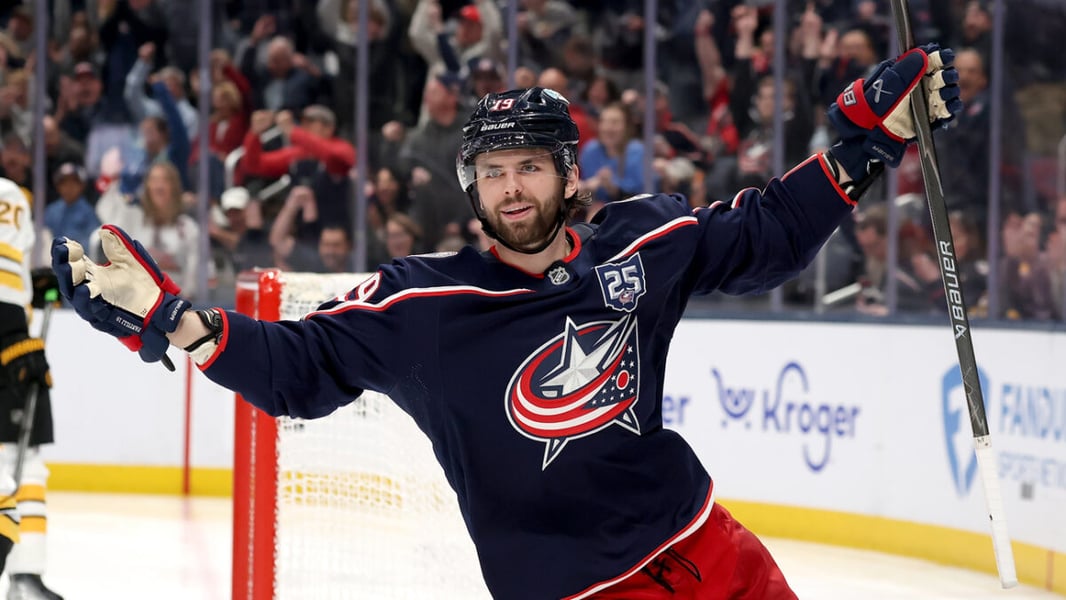
Adam Fantilli’s contract, signed just this week, is the clearest example of a team paying for potential. The Blue Jackets signed Fantilli to a six-year, $82.5 million extension through 2031-2032, and the $13.75 million average annual value is the largest in franchise history. Fantilli missed training camp during the contract standoff, and the deal got done a week before Columbus opens against Buffalo.

Fantilli’s tools are unquestioned. He has 140 points in 213 career games and has played all 82 games in each of the past two seasons, and his size at 6’2″, 194 pounds, paired with his speed, makes him a rare profile. However, the AB data raises real concerns. Fantilli’s AB Score actually declined in 2025-2026, from a peak of 2.57 down to 2.43. His 59-point season was solid, but the model values him at $7.68 million, 7.38% of the cap. Columbus is paying 13.2%, a $6.07 million premium per season, totaling over $36 million across six years.
His comparables make the point even clearer. Dylan Cozens posted the exact same 59 points with a higher AB Score (2.54), and his deal took 8.6% of the cap at signing. Dylan Strome produced 58 points with a 2.53 AB Score on a deal that took 6.1%. Will Smith, at 21, put up the same 59 points and a 2.65 AB Score while still on his entry-level deal at 1.1% of the cap. On a career basis, the model places Fantilli alongside Tomas Hertl, who signed at 10.0%, and Matty Beniers, who signed at 8.1%. Converted to today’s cap, Cozens’s deal would be worth about $8.9 million and Beniers’s about $8.4 million, still well short of $13.75 million. The only career comparable in Fantilli’s range is Leo Carlsson at 17.3%, which only reinforces how much the offer sheet distorted this market. Fantilli is being paid like Bedard. His numbers, at least so far, look like Cozens. Columbus is betting that the 2024-2025 version of Fantilli was the real one, and that he’ll surpass it. That might happen, but it’s a bet, not a certainty.
The Defensive Gambles: Nemec and Buium
If the forward contracts are aggressive, the defensive contracts are where the market has gone furthest past the data. Simon Nemec and Zeev Buium have proven very little at the NHL level, yet both are now paid like top-pair defensemen.
Nemec signed a five-year, $36.25 million contract with Calgary, an AAV of $7.25 million and 7.0% of the cap, after being traded by New Jersey. His AB trajectory is the most concerning of anyone in this article. He opened at 0.67 in 2023-2024, cratered to negative 0.20 in 2024-2025, and rebounded to just 0.83 last season. He has never once cleared the 1.14 replacement level. The model projects him at $3.26 million, 3.14% of the cap, meaning Calgary is paying more than double his projected share and nearly $4 million per season above market value. His comparables confirm it. Mason Lohrei, who posted a higher AB Score (1.29) on the same 26 points, signed at 3.4% of the cap. His career comparables, Mike Reilly and Nils Lundkvist, signed at 0.8% and 1.8%, respectively, while Ben Hutton’s peak deal never exceeded $2.80 million. Even the national coverage acknowledged it, as The Hockey News wrote that the Flames are paying for the player they hope Nemec becomes rather than the player he is right now.

Buium’s contract is an even bigger leap. Vancouver signed him to an eight-year, $75.04 million extension, and it begins in 2027-2028 and runs through 2034-2035, with a no-move clause and a 15-team no-trade list in years six through eight. The 20-year-old had three goals and nine assists in 45 games with Vancouver last season after arriving from Minnesota in the Quinn Hughes trade.

Buium’s 0.49 AB Score is less than half of the replacement-level threshold. His $9.38 million AAV will take 8.26% of the $113.5 million cap when it kicks in for 2027-2028. The model values him at $4.76 million, or 4.58% of the cap, meaning Vancouver is committing roughly $4.62 million per season above market value, or about $37 million in projected overpayment across eight years. His career comparables all signed for a fraction of that share. Zach Whitecloud (0.56) signed at 3.4%, Brayden McNabb (0.80) at 4.1%, and Henri Jokiharju (0.42) at 3.1%. Even converted to the 2027-2028 cap, those deals would land between $3.5 million and $4.7 million, roughly half of what Buium will earn. To be fair, Buium’s pedigree is real. He left Denver as the highest scoring U20 defenseman in the last 45 years of NCAA hockey, and the Canucks are in a position where cap space is less valuable during a rebuild. But the risk is that Vancouver locked in $9.38 million through 2035 based on what Buium did in college, not what he’s done in the NHL. If he develops into a 1.5 AB defenseman instead of a 3.0, this contract becomes an anchor for the next era of Canucks hockey, the one Ryan Johnson is trying to build.
Simon Edvinsson: The Next Domino
Simon Edvinsson is the next test case, and his situation shows exactly how the Nemec and Buium deals will ripple through the market. The 6’6″ Detroit defenseman posted 25 points and a 1.03 AB Score in 2025-2026, down from a 1.29 peak the year before. The model projects his fair market value at $4.73 million, 4.55% of the cap.

Here’s the problem for Detroit. Edvinsson’s 2025-2026 comparables include Nemec, who produced one more point with a lower AB Score and just signed at 7.0% of the cap. Edvinsson’s camp will point to that contract and to Buium’s 8.26% and argue that their client is the better player, which, according to AB, he is. His other comparables tell a different story. Mason Lohrei signed at 3.4% and Louis Crevier at 0.9%. His career comparables, Rasmus Ristolainen and Erik Cernak, each signed at 6.3% of the cap, while Nick Jensen signed at 2.2%. Applied to today’s $104 million cap, the Ristolainen and Cernak deals would equal roughly $6.5 million, which sets a realistic ceiling for Edvinsson, with AB’s $4.73 million projection as the floor. However, if this summer is any indication, the final number will land at or above the top of that range. The Red Wings will have to decide whether to pay the new market rate for a defenseman who hasn’t yet produced at a replacement level, or take a harder line and risk the relationship.
Ivan Demidov: How It Should Be Done
Of every contract in this article, Ivan Demidov’s is by far the best, and it isn’t close. Montreal signed Demidov to an eight-year, $73.2 million extension from 2027-2028 through 2034-2035, averaging $9.15 million annually. He led all NHL rookies in points, assists, and power-play points last season and finished second in Calder Trophy voting behind Matthew Schaefer.

Demidov posted a 2.85 AB Score as a rookie, and the model projects his value at $10.61 million, 9.39% of the $113 million cap in 2027-2028. Montreal is paying him $9.15 million, just 8.06% of the 2027-2028 cap. That’s roughly $1.46 million in surplus value per season, or nearly $12 million over the life of the contract, and that share of the cap will shrink even further as the ceiling rises to a projected $127.5 million. His comparables confirm it. Pavel Dorofeyev (2.77 AB) signed at 10.6% of the cap, more than Demidov for a lower score. Among his career comparables, Andrei Svechnikov signed at 9.5% and Troy Terry at 8.4%. Demidov produced a better AB Score than all three as a 20-year-old rookie, yet signed for a smaller share of the cap than any of them. Kent Hughes locked in a 20-year-old winger at below-market rate for eight years, a year before he even reached restricted free agency. That’s the model every GM should be studying.
Why New Jersey Got It Right
The move I want to see more GMs make is the one Sunny Mehta made in his first weeks on the job. New Jersey traded Nemec and Maxim Tsyplakov to Calgary for conditional first-round picks in 2027 and 2028, a 2026 second-round pick, and defenseman prospect Etienne Morin. Both first-round picks are top-10 protected. Mehta said the return from Calgary was too good to pass up and that moving on was ultimately the right thing for the organization.
The math proves him right. Had Mehta kept Nemec, New Jersey would have been paying roughly $4 million per season above AB market value for a defenseman who never reached replacement level in a Devils uniform. Worse, if another team had sent Nemec an offer sheet at $7.25 million, New Jersey would have only received a first, second, and third-round pick as compensation. Instead, Mehta recovered two firsts, a second, and a prospect, while keeping the cap flexibility to improve elsewhere.
This counters the narrative that teams must retain every young player at any cost. Drafting and retaining talent is more important than ever, but retaining the right talent at the right price is what separates good front offices from the rest. Not every former high pick is Bedard or Demidov. Sometimes the smartest thing a GM can do is recognize that another team values a player far more than the data does, and cash in.
Conclusion
The NHL’s contract economy has changed, and there’s no going back. The cap is heading toward $127.5 million, max contracts are about to cross $25 million, and the Carlsson offer sheet proved that any team leaving its young stars unsigned is vulnerable. However, the rising cap doesn’t make these contracts free. Across the five deals AB views as above market in this article- Carlsson, Bedard, Fantilli, Nemec, and Buium- the combined projected overpayment totals over $160 million. That money doesn’t disappear because the ceiling rises. It shows up as the depth player a team can’t afford, the trade deadline addition that never happens, or the next young star who has to be moved because the cap sheet can’t carry him.
The teams that win this era won’t be the ones that pay everyone. They’ll be the ones that pay the Celebrinis what they’ve earned, pay the Demidovs early, pay the Bedards fairly, and aren’t afraid to make the Nemec trade when the market gets ahead of the data.
Leave a Reply