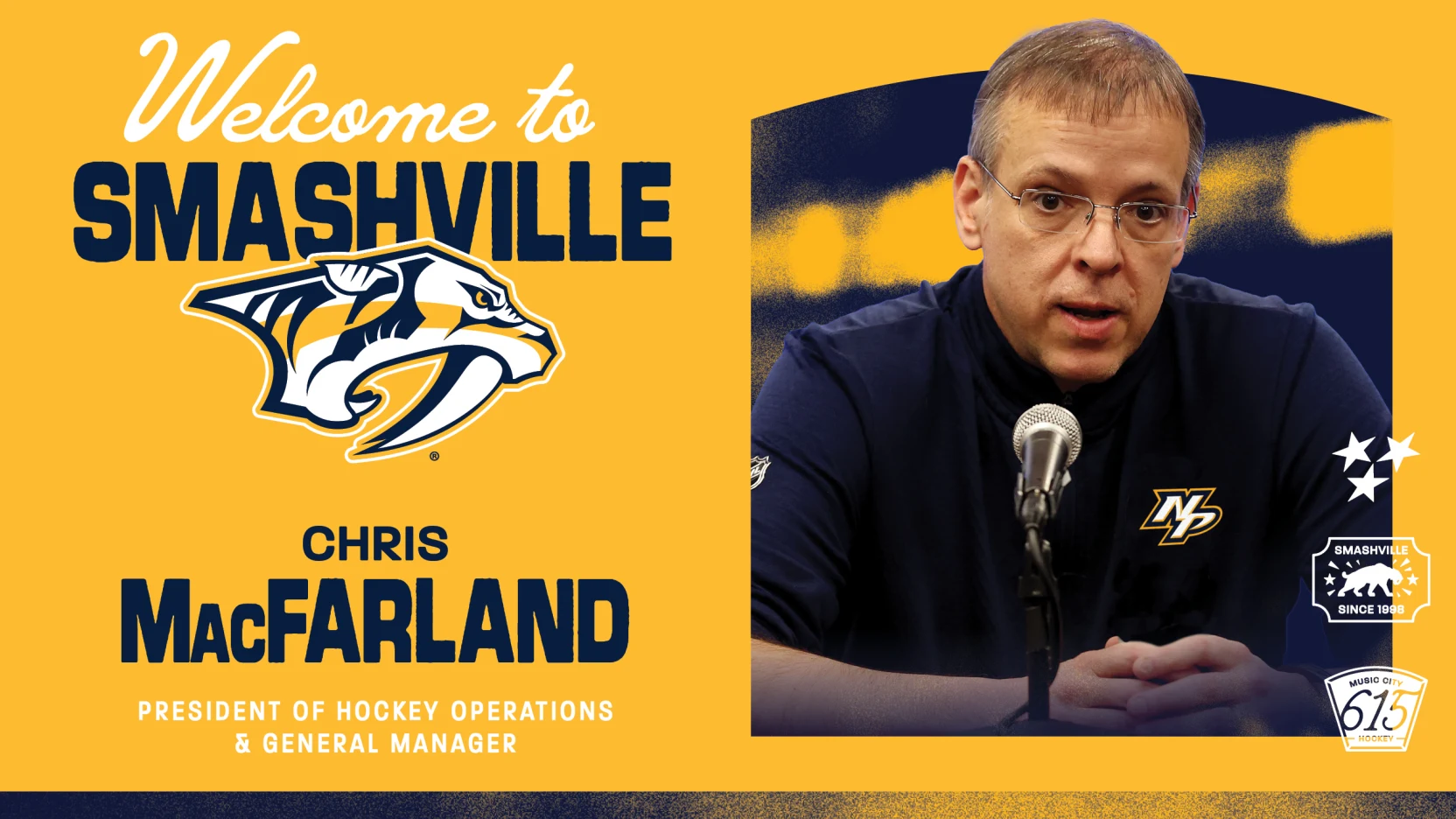
Today, the Nashville Predators officially hired former Colorado Avalanche General Manager and Stanley Cup Champion Chris MacFarland as their next GM and President of Hockey Operations. This hiring stuns the hockey world, as MacFarland is widely considered one of the best executives in the industry. The Predators enter the offseason at an organizational crossroads, making this summer one of the most important in franchise history. On paper, an 86-point season and a playoff push that remained competitive until the final weeks of the regular season could suggest that the Predators are a team capable of contention. However, a deeper analytical perspective indicates that MacFarland has his work cut out for him in his new role. Even if Nashville earned the final wild card spot in the Western Conference this season, the result likely would’ve been the same as the sweep the LA Kings suffered at the hands of the MacFarland’s Presidents’ Trophy-winning Colorado Avalanche in the first round.
The reality of this situation is what makes Chris MacFarland such an intriguing hire. The challenge he faces in Nashville is different: he takes over an aging roster approaching the end of its current competitive cycle, with a wave of young talent already in the organization that could potentially define its next era.
The Nashville Predators are currently one of the oldest teams in the league, with major financial commitments to veteran players already in their early to mid-thirties today. However, players already on the roster like Luke Evangelista and Matthew Wood, as well as their former 1st-round picks Brady Martin, Tanner Molendyk, and Yegor Surin, their 2024 2nd-round pick Teddy Stiga, and the 10th overall pick in the 2026 NHL Draft, provide optimism about the team’s future. For MacFarland, the challenge likely won’t be about how to keep the Predators competitive in the near future, but rather how aggressively the organization should begin transitioning to their next real era of contention.
The 2025-2026 Nashville Predators
The 2025-2026 Nashville Predators roster has a plethora of productive, veteran NHL players. However, the organizational focus- Chris MacFarland’s first of many pertinent questions, should be to address the glaring age and timeline of the current core. The graph below illustrates the AB outlook for the club this season, and presents further evidence of the underlying issue.

As the graph indicates, many of the Predators’ top contributors include Ryan O’Reilly (35), Filip Forsberg (31), Roman Josi (35), Steven Stamkos (36), and Jonathan Marchessault (35), yet everyone except Forsberg is already in their mid-thirties. While all except Marchessault finished well above the League AB replacement level in 2025-2026, projecting long-term production sustainability for players this age is a difficult task for any management team, especially as the league shifts toward faster, younger roster construction.
Even after missing the playoffs by just four points with a 38-34-10 record, Nashville, along with the other teams in the Western Conference playoff bubble (Los Angeles, St. Louis, San Jose, Winnipeg), never truly felt like legitimate Stanley Cup contenders this season. Although securing a playoff spot would’ve been a successful short-term outcome on paper, generating an extra $4 million in gate revenue from the two guaranteed additional home games in the first round, it’s likely a blessing in disguise for the long-term outlook of the franchise moving forward. Unlike the Los Angeles Kings, who traded prospects and draft picks at the deadline for established NHL players like Artemi Panarin for their playoff push, the Predators’ approach to the 2026 trade deadline was a smart one. It wasn’t a complete teardown, but they made a couple of value trades, dealing Michael McCarron to the Minnesota Wild for a 2028 2nd round pick, Cole Smith to the Vegas Golden Knights for a 2028 3rd round pick, Christoffer Sedoff, Nick Blankenburg to the Colorado Avalanche for a 2027 5th round pick, and Michael Bunting to the Dallas Stars for a 2026 3rd round pick. All of these players were pending UFA’s this summer, and creating opportunities for their younger players to play meaningful games down the stretch, as well as getting tangible assets for players they were likely going to lose this summer anyway, was a good strategy.
For incoming GM Chris MacFarland, viewing the Predators’ narrow playoff miss as evidence that the current roster requires minor short-term adjustments and doubling down on the all-in philosophy of his predecessor by allocating more financial resources and opportunities to veterans could further complicate the franchise’s long-term situation. As mentioned before, Nashville still has several productive veteran players, but the realistic timeline for the current group would be a statistical outlier compared to the trajectory of the league’s true contenders, like Colorado or Carolina.
However, this isn’t an organization without young talent, as Luke Evangelista’s emergence into a 2.70 AB player is one of the most encouraging developments from this 2025-2026 season. A later part of this article will discuss Evangelista’s importance to the organization’s future, but 2023 1st round pick Matthew Wood posted nearly 20 goals and an AB Score above replacement in his first full season as an NHLer, which is another positive sign. Along with prospects like Brady Martin, Tanner Molendyk, Yegor Surin, Teddy Stiga, and the upcoming 10th overall pick, Nashville has the potential for a youth movement sooner rather than later, providing a much-needed transition between their two organizational timelines.
Andrew Brunette’s Impact as Head Coach
Although the Predators missed the playoffs in 2025-2026, placing the majority of the blame on Head Coach Andrew Brunnette oversimplifies the larger situation in Nashville. As discussed in the previous section, the Predators have one of the oldest roster constructions of any team in the NHL, and the group’s timeline isn’t on par with that of the league’s true contenders. The coaching data illustrated in the graph below suggests that Brunette could remain with the team for 2026-2027, as his underlying numbers indicate he deserves credit for the team’s competitiveness as the season progressed.

Andrew Brunette extracted respectable value from the roster he was given last year and, according to the data, has a far more nuanced coaching profile than the Predators’ final standing would suggest. Brunette, like other coaches in recent articles, such as Sheldon Keefe (Analyzing Sunny Mehta’s Offseason Checklist For the New Jersey Devils- What Changes Need to Be Made? – hockey free for all.com (HOME OF THE ADVANCED BRACTON)) and Craig Berube (John Chayka Is Going To Work In Toronto- How the Leafs’ Contention Window Stays Open – hockey free for all.com (HOME OF THE ADVANCED BRACTON)), has a Coaching AB Score of 0.57, slightly above the study average of 0.46. However, Andrew Brunette’s Average Player AB Score of 1.36, relative to the Top-10 average of 1.30 and the study average of 0.95, is exceptional, indicating his ability to work with proven NHL talent and up-and-coming young players. While Brunette may not be in the upper echelon of NHL coaches, the broader data strongly suggest he remains a quality NHL coach capable of navigating the eventual transition Nashville will need to make towards its youth movement.
One of the more underrated aspects of the Nashville Predators, from an organizational perspective, has been their lack of leadership turnover. Including Brunette, Nashville has only had four head coaches in its 27-year franchise history, while Chris MacFarland will become just the franchise’s third General Manager. Unlike organizations that operate with short-term impatience and a lack of monetary care when firing coaches and executives, the Predators have valued continuity and long-term organizational direction. Given that Brunette outperforms the study average in every statistical category, and his positive developmental strides with younger talent like Luke Evangelista and Matthew Wood, the data suggest Nashville’s longer-term questions are more likely related to roster timeline and organizational direction than to the performance of the coaching staff at this moment. Based on the data, Brunette can make a legitimate case that he is the right coach to guide the Predators through their next organizational phase.
Nashville Predators Salary Cap Outlook
One of the most fascinating aspects of Nashville’s current organizational outlook is that many of the team’s largest contracts aren’t poor deals, but are significant financial commitments to players on the wrong side of 30. As the roster construction section outlined, several of these veteran players still produced quality AB results in 2025-2026 and will likely remain positive NHL contributors entering 2026-2027. However, the challenge for MacFarland and the incoming Predators’ front office is determining whether each player’s timeline realistically aligns with Nashville’s next legitimate contention window.

The graph illustrates both strengths and concerns surrounding the Predators’ current cap structure. As AB is only a skater statistic, this graphic does not account for the $7.74 million AAV the team has allocated to 31-year-old goaltender Juuse Saros until 2033. Even at 31, Filip Forsberg continues to provide excellent value relative to his contract and will certainly be one of the organization’s more important offensive players in the coming years. Ryan O’Reilly and Steven Stamkos also continued their positive AB results, and Roman Josi remains one of the NHL’s best and most impactful defensemen when healthy. These aren’t contracts, despite their AAV and term, given to ineffective players.
However, although his contract is fair market value according to the model, Brady Skjei making $7 million for the next five seasons while posting a below-replacement AB score at 32 years old is concerning. Jonathan Marchessault also projects as a below-replacement AB player and a roughly $2 million overpayment according to the model, and he’s signed for 3 more seasons until he turns 38. Collectively, these names, along with 36-year-old Steven Stamkos, 35-year-old Ryan O’Reilly, and 35-year-old Roman Josi, place Nashville in a difficult long-term balancing act as they seek to remain competitive while preparing for the eventual transition to their next wave of young talent.
The balancing act is likely where MacFarland’s experience in Colorado can be applicable. During his tenure, the Avalanche made substantial, bold decisions in the trade market, sending Mikko Rantanen to the Carolina Hurricanes and acquiring Brock Nelson from the New York Islanders in exchange for significant draft and prospect capital. With the NHL salary cap continuing to rise, Nashville’s contracts become more manageable and likely easier to trade if MacFarland opts for that route. However, the points from previous sections of this article become even more important: MacFarland shouldn’t double down and add unnecessary short-term veteran additions to this group, which would block younger players from stepping into meaningful NHL opportunities during this time of transition. Perfect examples this season include Matthew Wood and Luke Evangelista, who thrived in their assigned roles and appear to be building blocks for the Predators’ new era.
Luke Evangelista’s Importance to Nashville’s Future
While much of this article has focused on the Predators’ aging veteran core and the dilemma of balancing the organization moving forward, players like Luke Evangelista are exactly why there’s optimism for the Predators’ long-term outlook. As mentioned before, Evangelista’s emergence during the 2025-2026 season was one of the more encouraging developments for the club, not only because of his 56-point season but because of what his statistical profile possibly represents in the modern NHL.

At 24 years old, Evangelista posted a 2.7 AB score while substantially outperforming his current contract, with the model projecting a salary more than double his current cap hit. More importantly, his success came from recording an average of over 3 additional minutes of ice time from 2024-2025 to 2025-2026 under Coach Brunette, as well as an increase of 24 recorded points over that span. For an organization like Nashville, preparing to navigate a complicated transition between eras, younger players like Evangelista, capable of handling larger roles at the NHL level, are incredibly important, as he may take a further step with a bigger opportunity next season.
From MacFarland’s perspective, players like Evangelista may be some of the most important pieces in determining how aggressive Nashville is in the next few years. As discussed throughout this article, they still have enough veteran talent to remain competitive in the short term; however, the organization’s ability to return to true contention will depend far more on the continued development of players like Evangelista already in their system than on looking externally to expand a diminishing window of their current core. Evangelista, Matthew Wood, and the bevy of young prospects mentioned throughout this work are the ones who will define the next era of Predators hockey, and it’ll be exciting to track their development in future years.
Conclusion
The Nashville Predators face one of the most important offseasons in franchise history. The challenge is what makes Chris MacFarland such a great fit. His decision to leave one of the best situations a GM can have to take over the Predators is one of the boldest executive changes in recent hockey memory, and if he’s able to apply the same level of creativity and gusty decision-making in Nashville, then the Predators just got the perfect executive to lead them into a new era.
Leave a Reply