
The Pittsburgh Penguins are in unfamiliar territory after failing to qualify for the Stanley Cup playoffs for the third straight season. Excluding the lockout and COVID-shortened seasons, their 80 recorded points in 2024-25 were the 2nd lowest total of the Crosby era, trailing only his rookie year’s 58. Heading into the 2025-26 season, there is speculation regarding the future of the club’s longtime captain, as well as that of fellow franchise stalwarts Evgeni Malkin and Kris Letang. Rookie coach Dan Muse and an infusion of youth suggest patience, yet the case can be made that expectations ought to be higher.
When Kyle Dubas took over in Pittsburgh on June 1st, 2023, he was tasked with rebuilding a depleted prospect pool and ushering in the next generation of Penguins after the Crosby era. Just two years earlier, I wrote about the uncertainty surrounding the Penguins under Ron Hextall and Brian Burke (Front Office Shakeup in Pittsburgh, Why There Is Reason for Concern – hockey free for all.com (HOME OF THE ADVANCED BRACTON)), and why there was “reason for concern” with the lack of a clear vision and virtually no young talent on the horizon. At that time, a true rebuild seemed daunting. The organization was still struggling, yet the prospect pool was bleak, and there was no coherent path forward. Fast forward to today, and the situation feels strikingly different. Thanks to Dubas’ aggressive accumulation of draft capital and immediate prospect development success, the Penguins are now in a far stronger position than they were under the previous regime. With quality management in place and a replenished pool of young talent, Pittsburgh has both the structure and the resources to navigate this transition and return to contention sooner rather than later.
Since his first draft in 2023, Dubas has made four first-round picks in Braden Yager (traded for Rutger McGroarty), Benjamin Kindel, Bill Zonnon, and Will Horcoff, and a plethora of second-round picks, including Harrison Brunicke and Tanner Howe. All of these players are positive TAB players, except for Horcoff (and slightly negative Brunicke), and are poised to become significant contributors to the club in the near future. The Tentative AB (TAB) Score is a foundational metric for early-stage evaluations, designed to complement traditional scouting by providing a data-driven estimate of a prospect’s potential for success in the NHL. Derived from junior and pre-NHL performance data, it captures about 80% of what a player’s eventual Advanced Bracton (AB) Score (more on AB later) might be, highlighting “diamonds in the rough” and refining scouting focus (more information in this article here Tentative AB Explanation – hockey free for all.com (HOME OF THE ADVANCED BRACTON)). Notably, Harrison Brunicke has garnered interest as he came very close to making the roster last year out of training camp. There should be ample opportunities for him, as well as fellow first-round pick (from 2022) Owen Pickering, to start the season with the club. AB analysis indicates that the Penguins have multiple defensemen performing below replacement level, suggesting that handing the responsibilities to the younger players might lead to greater success. More on this will be discussed later in the article.
An additional example of Dubas’s exceptional management skills is evident in the Penguins’ current salary alignment. The Arbitration Analyzer is a salary projection tool within the AB metric family, designed to estimate an NHL player’s fair earnings relative to the league. The Advanced Bracton (AB) Score itself is the cornerstone of this system. This proprietary metric quantifies a player’s on-ice impact by measuring intelligence, discipline, mistake minimization, and situational awareness. At its core, the AB Score evaluates how players generate “unscored goals at the margin” (UGM), meaning the subtle contributions that prevent goals against or create advantages not captured in traditional statistics (more on the AB can be found in this article THE BRACTON AND ADVANCED BRACTON SCORES – hockey free for all.com (HOME OF THE ADVANCED BRACTON)).
The analyzer tool operates similarly to a real arbitration case, where arguments are based on statistical comparables. The model considers a player’s production, specifically points and the proprietary AB Score, assigning weights with AB Score given the most importance. These numbers are averaged over the player’s career up to the target season to create a performance profile, which is then compared to similar players from past years with similar output and roles. In calculating a similarity score based on these metrics, the tool finds the closest historical matches and derives a projected salary by averaging their actual earnings. This provides a fair-market benchmark, indicating whether a player is overpaid, underpaid, or aligned with league standards. Built in Python, the analyzer utilizes popular data science libraries—pandas for data handling, NumPy for calculations, and scikit-learn for preprocessing and weighting —trusted throughout sports analytics and research. Here is the outlook for the Penguins’ 2025-26 team, along with a comparison of their contracts, according to AB.
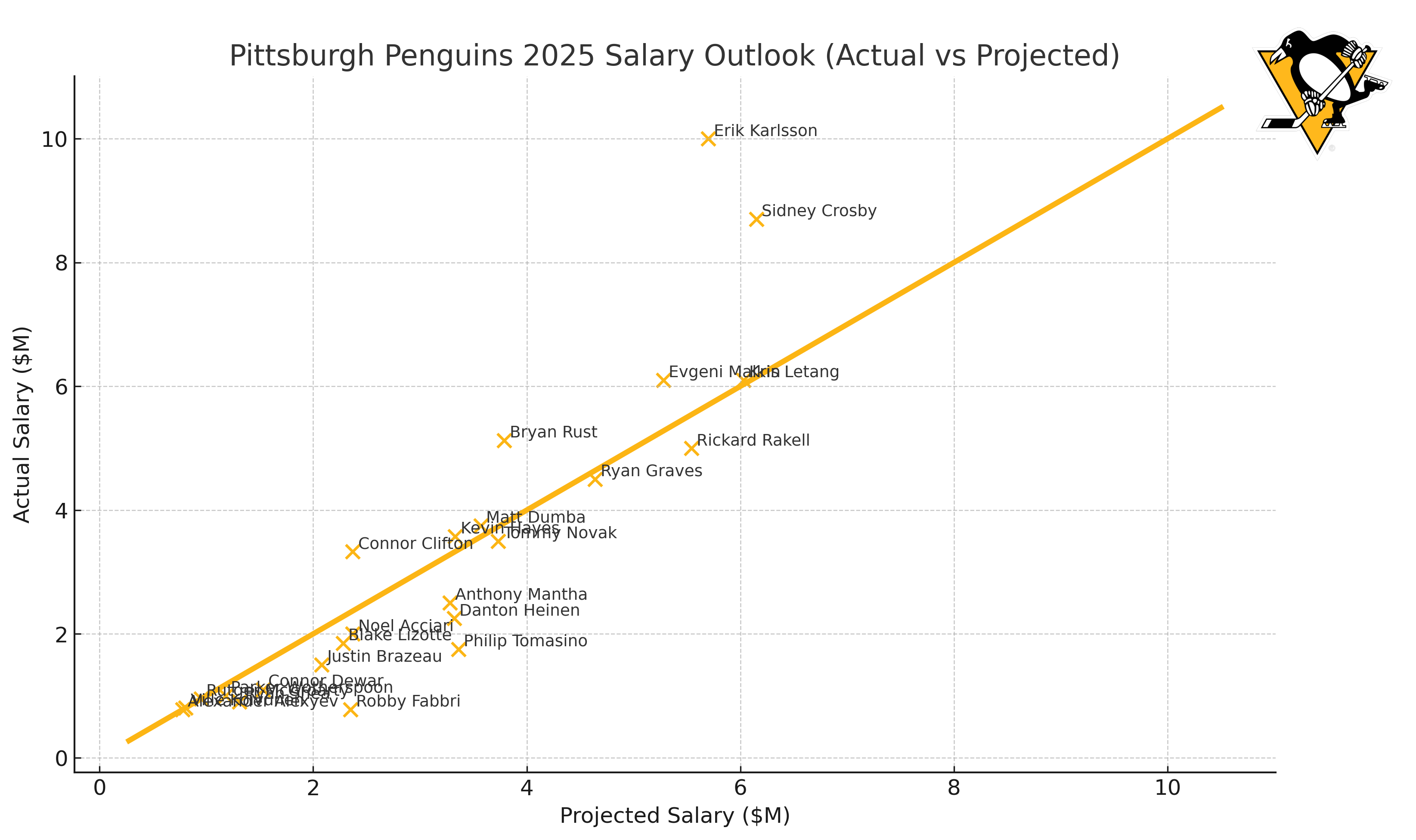
This chart displays the Pittsburgh Penguins’ 2025 Salary Outlook, comparing each player’s actual salary on the y-axis with their estimated fair-market salary on the x-axis based on the Arbitration Analyzer. Players positioned directly on the orange trend line are earning roughly in line with expectations. Those above the line are earning more than their projection, while those below are earning less. Overall, the actual and projected salaries of most players closely match, reflecting the model’s effectiveness in estimating market value.
The one notable outlier is Sidney Crosby, who appears above the projection line. The model, based on statistical comparables, suggests a slightly lower salary than his current deal. However, this discrepancy reflects the limitations of purely data-driven measures: Crosby is coming off a 93-point season and brings immeasurable leadership and franchise value that extend beyond on-ice production. Far from undermining the model, this underscores that arbitration-style analyses are designed to quantify the performance-based value of salaries. At the same time, the realities of generational players and intangibles often command a premium.
Beyond the marquee names, the chart also emphasizes the depth Kyle Dubas has built around the Penguins’ core. Players like Philip Tomasino, Danton Heinen, and Noel Acciari all appear below the trend line, meaning their actual salaries are lower than what the model suggests they should be earning. These contracts offer surplus value, as they feature players who can produce significant results at relatively low cap hits. For a team working within the tight limits of the NHL salary cap, these types of depth signings are essential. They not only protect the roster against injuries and slumps but also create flexibility to keep the team competitive as it transitions from the Crosby-Malkin-Letang era to a younger core. Additionally, the club has nearly $12 million in cap space, giving it flexibility in trade negotiations this season. This allows them to acquire more assets and leverage that space to their benefit.
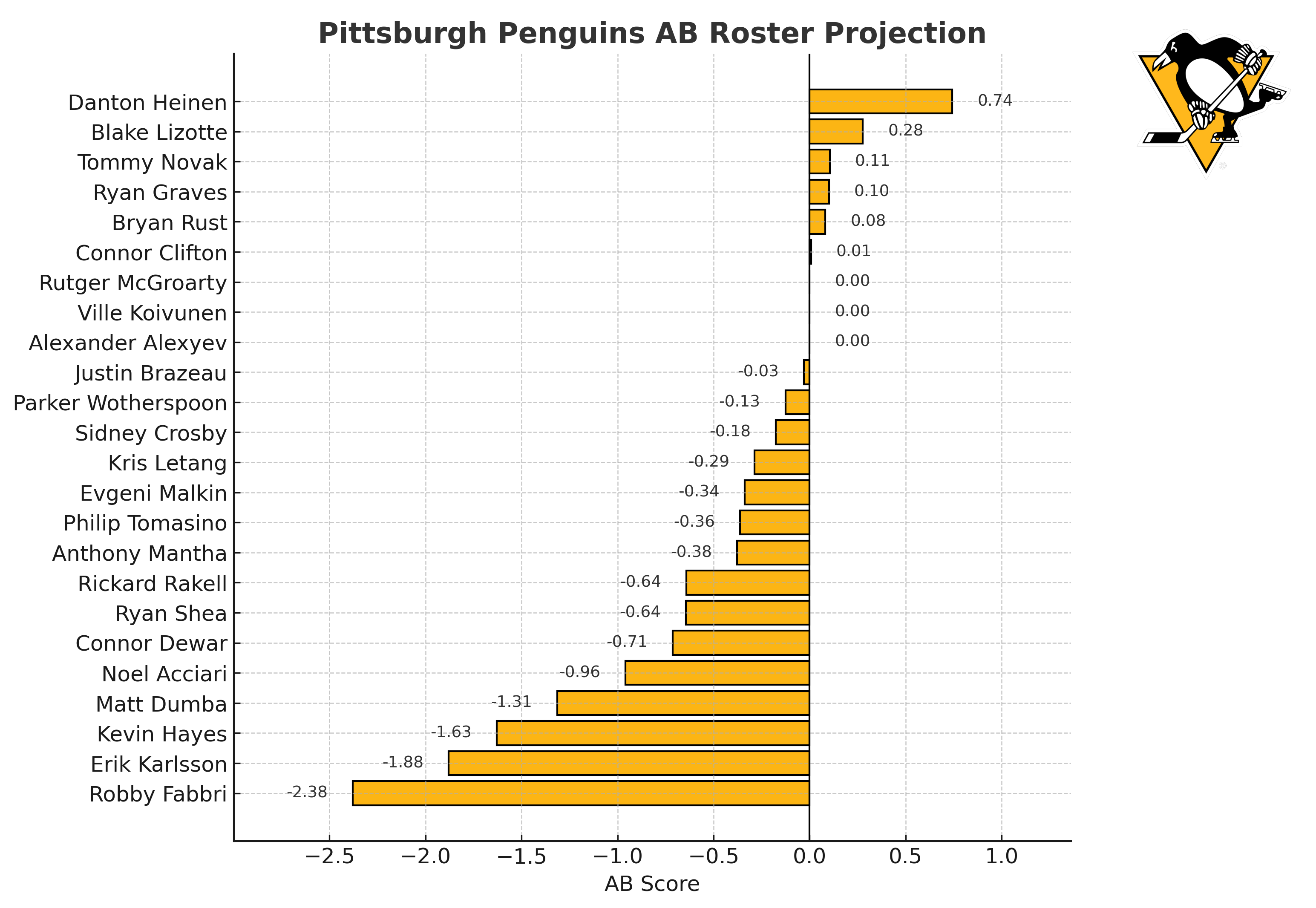
While salary figures offer one perspective on team building, the AB Roster Projection above provides a performance-based snapshot of the Penguins’ standing heading into the 2025–26 season. This model assesses each player’s AB Score, revealing both strengths and weaknesses in the roster. Depth forwards like Danton Heinen and Blake Lizotte emerge as clear positives, offering efficient bottom-six production at minimal cost. Conversely, players such as Erik Karlsson, Robby Fabbri (who shouldn’t make the team on PTO), and Kevin Hayes rank lower, indicating they underperform relative to expectations. Notably, Dubas has balanced his aging core with low-risk, potentially high-value players, while maintaining flexibility to part ways with contracts that fall behind. This combination of bargain depth pieces and movable veterans shows that Pittsburgh’s roster isn’t just patched together; it’s designed for adaptability, allowing the team to remain competitive now while keeping future options open.
Despite this, I am not claiming that the 2025-26 Pittsburgh Penguins will reach the Stanley Cup Playoffs. For this article, I developed a point predictor model to estimate the final standings in the Metropolitan Division for this season. The Points Predictor converts a team’s season-long AB Score, a metric of overall roster performance, into projected points in the standings. Its approach is simple yet effective: it compares each NHL team’s historical AB score with their actual points, then applies a basic linear regression to find a straight-line relationship. This relationship is expressed through the formula Points = slope × AB + intercept. Once the line of best fit is determined, plugging a team’s AB score into the formula instantly yields a projected points total for the season. The model is implemented in Python, utilizing trusted data science libraries such as Pandas for data management, NumPy for numerical accuracy, and scikit-learn’s LinearRegression function to fit the model. It results in a straightforward and transparent predictor that offers a data-driven benchmark for how a team’s roster should translate on-ice performance (via AB) into the standings. It avoids complicated layers of adjustments, instead establishing a simple, league-wide baseline that indicates whether a team performs above or below expectations relative to its AB score.
The results predicted the Penguins to finish with 85 points and place 4th in the division, trailing Carolina, the NY Rangers, and Washington in that order. Initially, this was a surprising outcome, as having Pittsburgh, a team many projected to be among the worst in the league, finish ahead of the Devils, Flyers, Blue Jackets, and Islanders is certainly bold. When comparing this 85-point projection to that of the major sportsbooks, the chart below highlights the discrepancy.

While the model forecasts the Penguins to reach 85 points, sportsbooks are more conservative, with over/under lines from 74.5 to 76.5. This discrepancy indicates a lack of confidence from oddsmakers, who see Pittsburgh as closer to the league’s lower tier. Still, considering the Penguins’ combination of productive veteran players, emerging young talent, and substantial depth (especially among forwards), it’s plausible they could exceed expectations, much like their division rivals, the Washington Capitals, have in recent seasons. If the Penguins can secure steady goaltending from newly acquired Arturs Silovs and a bounce-back performance from Tristan Jarry, they may have a real chance to surprise people.
Ultimately, the 2025–26 Penguins enter the season at a crossroads, but one defined more by possibility than inevitability. The organization now boasts a clearer direction than it has in years, with Dubas’ calculated roster management, a replenished prospect pool, and the flexibility to pivot as the year unfolds. Whether they surpass the modest expectations set by sportsbooks or fall short will depend on how quickly their youth can complement the aging core, but for the first time in a long time, Pittsburgh’s path forward feels structured and sustainable. That alone marks a significant shift, one that suggests the Penguins, under Kyle Dubas’ leadership, are laying the groundwork for a competitive future, where short-term results matter, but long-term stability finally feels within reach again.
 hockey free for all.com (HOME OF THE ADVANCED BRACTON)
Leave a comment