
In June 2016, businessman Bill Foley and Black Knight Sports & Entertainment were officially awarded the 31st National Hockey League team, as well as the first major professional sports team in Las Vegas with the Golden Knights. Since the team’s inception, Foley has been known to be one of the league’s most aggressive owners, even proclaiming that the VGK would deliver a Stanley Cup to Sin City by year six of existence. Tonight, on June 13th, 2023, Foley’s Golden Knights fulfilled that promise, as they defeated the Eastern Conference Champion Florida Panthers in five games. The Golden Knights have been one of the most interesting, most successful franchises in the NHL since their inaugural season in 2017-18 and have been the primary subject of several of my research studies throughout that same period. I believe there are many things the other thirty-one NHL teams can learn from the Golden Knights on and off the ice, several of which will be discussed in this article. In this study, I will analyze the 2022-2023 Vegas Golden Knights based on AB roster construction (like our Colorado Avalanche team of destiny article from last season), discuss the aggressive mentality of the Knights’ management/ownership group, as well as debunk the narrative the Golden Knights were “gifted” a good team from the start.
The Components of a Stanley Cup Champion in the AB Score Era
Last season, I conducted a study to determine whether there were any noticeable trends among the fifteen Stanley Cup Champions as it pertains to AB (see the article, The 2021-2022 Colorado Avalanche- A Team of Destiny). Most of this section of the article will repeat information and results found in last year’s study and how the Golden Knights compared to the rest of history. Since publishing my Colorado study last season, the overall AB score formula was modified. For the sake of this article, however, I adjusted the formula to reflect that of the previous one for the purpose of data consistency. In doing so, I found that the Golden Knights exceeded the mark on three of the four discovered AB trends of championship rosters, and slightly missed on the fourth. Only two playoff teams exceeded the mark on all four trends, those being the Seattle Kraken and Boston Bruins, which is why they were my predicted Eastern/Western Conference champions prior to the playoffs. However, AB again predicted the champion when it was down to the final two teams, as the difference between Vegas and Florida’s team AB scores for the 2022-23 season was over sixty AB points in the Golden Knights’ favor. The table below shows the team AB scores of the last fifteen champions as well as this year’s Golden Knights team.
Regular Season Team AB Scores of the Sixteen Stanley Cup Champions of the AB Era
| Year | Champion | Score | Highest (Y/N) |
| 2007-2008 | Detroit Red Wings | +85.79 | Yes |
| 2008-2009 | Pittsburgh Penguins | +27.38 | No |
| 2009-2010 | Chicago Blackhawks | +119.55 | No |
| 2010-2011 | Boston Bruins | +124.51 | Yes |
| 2011-2012 | Los Angeles Kings | -11.17 | No |
| 2012-2013 | Chicago Blackhawks | +94.52 | Yes |
| 2013-2014 | Los Angeles Kings | +59.83 | No |
| 2014-2015 | Chicago Blackhawks | +53.02 | No |
| 2015-2016 | Pittsburgh Penguins | +74.84 | No |
| 2016-2017 | Pittsburgh Penguins | +77.96 | No |
| 2017-2018 | Washington Capitals | +27.91 | No |
| 2018-2019 | St. Louis Blues | +26.26 | No |
| 2019-2020 | Tampa Bay Lightning | +76.27 | No |
| 2020-2021 | Tampa Bay Lightning | +28.50 | No |
| 2021-2022 | Colorado Avalanche | +122.52 | No |
| 2022-2023 | Vegas Golden Knights | +97.81 | No |
The average AB score of a Stanley Cup championship team of +65.846 was the first trend the Golden Knights eclipsed, as their +97.81 adjusted team AB score is the second highest team AB score of a Stanley Cup champion (behind only the 2021-22 Avalanche) dating back to 2010-11. This was also the fourth-highest AB of a championship team since the metric’s inception. They were one of nine teams to meet this mark prior to the playoffs, as those teams were Boston (+233.92), New Jersey (+128.13), Carolina (+84.83), Toronto (+72.90), New York Rangers (+75.09), Seattle (+105.13), Vegas (+97.81), Edmonton (+93.03), Dallas (+96.34). Also, like all but two prior champions before them, the Golden Knights also did not record the highest overall team AB score at the conclusion of the regular season, as this year’s Boston Bruins team had a +233.92 score, which was the highest recorded score of all time.
The AB Positive to AB Negative Player Ratio of the Sixteen Stanley Cup Champions of the AB Era
| Year | Champion | Ratio (Positive/Negative) | Percentage Positive |
| 2007-2008 | Detroit Red Wings | 13:9 | 60% |
| 2008-2009 | Pittsburgh Penguins | 17:11 | 60% |
| 2009-2010 | Chicago Blackhawks | 21:2 | 91% |
| 2010-2011 | Boston Bruins | 17:7 | 70% |
| 2011-2012 | Los Angeles Kings | 7:17 | 29% |
| 2012-2013 | Chicago Blackhawks | 19:4 | 83% |
| 2013-2014 | Los Angeles Kings | 14:7 | 67% |
| 2014-2015 | Chicago Blackhawks | 15:8 | 65% |
| 2015-2016 | Pittsburgh Penguins | 21:5 | 78% |
| 2016-2017 | Pittsburgh Penguins | 17:6 | 74% |
| 2017-2018 | Washington Capitals | 12:6 | 67% |
| 2018-2019 | St. Louis Blues | 13:13 | 50% |
| 2019-2020 | Tampa Bay Lightning | 13:12 | 52% |
| 2020-2021 | Tampa Bay Lightning | 15:6 | 71% |
| 2021-2022 | Colorado Avalanche | 18:8 | 69% |
| 2022-2023 | Vegas Golden Knights | 20:7 | 74% |
The graphic above shows the ratio of AB positive to AB negative players on the sixteen Stanley Cup championship teams, as well as the percentage of total positive players on each team. The average prior to this season of 65.73% positive players per team was the second mark the Golden Knights exceeded. The Golden Knights’ positive to negative AB player ratio was 20:7 74%, the highest ratio recorded since the 2016-17 Pittsburgh Penguins recorded the same during their 2nd straight finals win. Prior to the playoffs, of the nine potential championship teams I mentioned earlier, only the Toronto Maple Leafs (63%), and the New York Rangers (56%) failed to eclipse that mark.
Players on Stanley Cup Championship Teams with a +10 AB Score Or Higher
| Year | Champion | Player Names | Respective Scores |
| 2007-2008 | Detroit Red Wings | Datsyuk, Zetterberg, Lidstrom, Samuelsson, Cleary, Filppula, Rafalski | +29.5,+18.07,+16.08,+13.47,+12.14,+10.84,+10.67 |
| 2008-2009 | Pittsburgh Penguins | Malkin, Kennedy | +12.27, +10.17 |
| 2009-2010 | Chicago Blackhawks | Toews, Hossa, Kane, Sharp | +14.73, +13.79, +12.60, +11.72 |
| 2010-2011 | Boston Bruins | Chara, McQuaid, Horton, Krejci, Marchand, Lucic, Ference, Bergeron | +15.37, +14.77, +14.34, +12.49, +12.43, +11.05, +10.44, +10.32 |
| 2011-2012 | Los Angeles Kings | Brown | +12.66 |
| 2012-2013 | Chicago Blackhawks | Toews, Hossa | +16.17, +10.78 |
| 2013-2014 | Los Angeles Kings | Kopitar, Toffoli | +18.36, +11.26 |
| 2014-2015 | Chicago Blackhawks | Toews | +16.65 |
| 2015-2016 | Pittsburgh Penguins | Kunitz, Maatta, Crosby, Hornqvist | +14.60, +12.06, +10.79, +10.30 |
| 2016-2017 | Pittsburgh Penguins | Sheary, Schultz | +12.99, +10.11 |
| 2017-2018 | Washington Capitals | NONE | NONE |
| 2018-2019 | St. Louis Blues | O’Reilly, Parayko | +14.75, +10.27 |
| 2019-2020 | Tampa Bay Lightning | Cirelli, Point, Palat, Hedman, Kucherov | +17.97, +16.32, +13.33, +13.21, +11.96 |
| 2020-2021 | Tampa Bay Lightning | NONE | NONE |
| 2021-2022 | Colorado Avalanche | Toews, Makar, Rantanen, MacKinnon, Nichushkin | +25.36, +24.48, +18.31, +13.90,+12.00 |
| 2022-2023 | Vegas Golden Knights | Eichel, Martinez | +13.42, +14.61 |
The third trend I discovered in last year’s study was that 73% of Stanley Cup championship teams had a center with a +10 or higher individual AB score recorded in the regular season, as well as two or more players who exceeded that mark. This year’s Vegas Golden Knights had center Jack Eichel record a +13.42 individual AB score, as well as defenseman Alec Martinez record a +14.61 score. Prior to the playoffs, of the seven remaining potential championship teams to this point, only the Carolina Hurricanes failed to accomplish this feat.
Average and Combined Individual AB Scores of Top-Pairing Defensemen of the last Sixteen Stanley Cup Championship Teams
| Year | Champion | Pairing | Pairing Total AB/Average |
| 2007-2008 | Detroit Red Wings | Lindstrom (+16.08)/Rafalski (+10.84) | +26.92 (+13.46 AVG) |
| 2008-2009 | Pittsburgh Penguins | Orpik (+1.48)/Gonchar (-3.75) | -2.27 (-1.135 AVG) |
| 2009-2010 | Chicago Blackhawks | Seabrook (+8.82)/Keith (+9.20) | +18.02 (+9.01 AVG) |
| 2010-2011 | Boston Bruins | Chara (+15.37)/Seidenberg (-0.14) | +15.23 (+7.615 AVG) |
| 2011-2012 | Los Angeles Kings | Scuderi (-5.02)/Doughty (-2.9) | -7.92 (-3.96 AVG) |
| 2012-2013 | Chicago Blackhawks | Seabrook (+4)/Keith (+6.22) | +10.22 (+5.11 AVG) |
| 2013-2014 | Los Angeles Kings | Muzzin (-0.41)/Doughty (+4.05) | +3.64 (+1.82 AVG) |
| 2014-2015 | Chicago Blackhawks | Keith (+3.34)/Hjalmarsson (+9.08) | +12.42 (+6.21 AVG) |
| 2015-2016 | Pittsburgh Penguins | Letang (+2.06)/Maatta (+12.06) | +14.12 (+7.06 AVG) |
| 2016-2017 | Pittsburgh Penguins | Dumoulin (-0.12)/Letang (+0.26) | +0.14 (+0.07 AVG) |
| 2017-2018 | Washington Capitals | Orlov (+6.34)/Niskanen (+7.61) | +13.95 (+6.975 AVG) |
| 2018-2019 | St. Louis Blues | Edmundson (-2.26)/Pietrangelo (+1.77) | -0.49 (-0.245 AVG) |
| 2019-2020 | Tampa Bay Lightning | Hedman (+13.21)/Sergachev (+4.10) | +17.31 (+8.655) |
| 2020-2021 | Tampa Bay Lightning | Hedman (+1.45)/Sergachev (-0.28) | +1.17 (+0.585) |
| 2021-2022 | Colorado Avalanche | Makar (+24.48)/Toews (+25.36) | +49.84 (+24.92) |
| 2022-2023 | Vegas Golden Knights | Martinez (+14.61)/Pietrangelo (+6.60) | +21.21 (+10.60) |
Prior to this season, the average combined top defense paring score of Stanley Cup Championship teams was +11.48. As Vegas’ Alec Martinez and Alex Pietrangelo only combined for a +10.60 average, this was the only one of our four trends that the Golden Knights did not exceed. Despite this, their +10.60 average was among the higher pairing averages of championship teams recorded to this date, as they fall only behind last year’s Colorado Avalanche (+24.92), and the 2007-08 Detroit Red Wings (+13.46). This year, they were not alone however, as the New Jersey Devils, Dallas Stars, and Edmonton Oilers also failed to reach this mark, leaving the Seattle Kraken and Boston Bruins as the only two teams to surpass all four benchmarks this season as I mentioned before.
To conclude this section of my analysis, I believe the 2022-2023 Vegas Golden Knights were adequately constructed in accordance with the standards of AB championship teams of the past. In the next section of my work, I will discuss how these players were acquired, and that the aggressive approach the organization has taken regarding talent acquisition on and off the ice is a lesson that all professional sports teams should attempt to learn.
An Analysis of The Talent Acquisition Practices of the Vegas Golden Knights Ownership/Management
As an aspiring General Manager, watching the work of Golden Knights President of Hockey Operations George McPhee, and General Manager Kelly McCrimmon over this six-year period has been nothing short of inspiring. The high frequency of bold moves and decision-making of this tandem, although uncommon, may encourage other teams to follow suit throughout the foreseeable future. To me, it appears that the duo was willing to do whatever it took to help the club win games since the very beginning, as the expansion draft strategy of accumulating draft picks and other assets for the sole purpose of trading for significant pieces of this championship core only made this more apparent. Very rarely in today’s NHL do we see a management group formulate a six-year plan, apply it, and deliver the results the Golden Knights have. Starting with the actual expansion draft, six players of the original Vegas Golden Knights team remain as part of the Stanley Cup Championship core (Jonathan Marchessault, Reilly Smith, Brayden McNabb, Shea Theodore, William Karlsson, and William Carrier). The post-expansion draft Golden Knights roster is depicted below for reference.
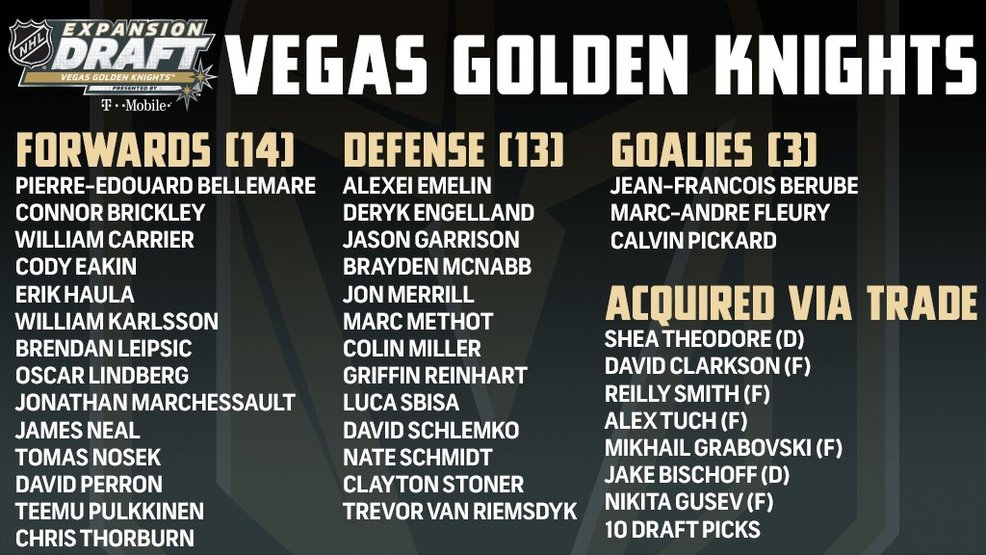
Not only were McPhee and his management team able to identify “diamonds in the rough” with Carrier, Karlsson, Marchessault (now Conn Smythe Winner), and McNabb in the actual expansion draft, he was actually paid assets to take on Theodore and Smith. This isn’t even counting the fact that David Perron, Marc-Andre Fleury, and Alex Tuch (other selections and pieces acquired) were critical players during the club’s inaugural season, falling three wins short of their own Stanley Cup (see the article, Vegas- How 23 Castaways are in 1st Place). The whole point of the AB score and the work I do here at Hockeyfreeforall.com is to identify areas of mistake minimization on and off the ice for players and management. With that being said, I believe George McPhee, and Kelly McCrimmon after him, have made the fewest mistakes of any general managers over the last six seasons. It is because of their elite decision-making abilities that the 2022-23 Golden Knights are Stanley Cup Champions, not because of “rigged favorable expansion draft rules” as many hockey fans believe. I hope to provide some context behind the previous statement, as I hope that as a result of their championship win, McPhee and McCrimmon are credited in higher regard, shifting the narrative from a negative one to one that acknowledges good, and bold decision-making.
During my analysis and study of General Manager decision-making, there are certain tendencies McPhee and McCrimmon have that differentiate them from the other seventy-seven GMs in my study. For example, throughout his time as General Manager of the Washington Capitals and Vegas Golden Knights, no GM has allocated more total dollars towards positive AB players in contract negotiations than George McPhee, as he has spent $813,012,750. To put this into perspective, the second most money spent on positive players was by Steve Yzerman of the Detroit Red Wings with $775,159,401, a difference of over $37.8 million. This tells me that McPhee places a great deal of emphasis, whether he intends to or not, in retaining/acquiring players of high intellect and mistake-minimization capability. Despite only being the Golden Knights’ General Manager for just shy of three seasons, I believe Kelly McCrimmon shares this vision, as he has already spent $166,457,450 on positive AB players, higher than longer-tenured GMs such as Brian Burke and Pierre Dorion. I plan on revealing more information in later works, as the methodology behind an entire General Management metric is still undergoing experimentation.
In trade markets, more similarities between the two men’s management styles become apparent. Neither are afraid to make a splash, face controversy during the process, or quickly admit when they’re wrong and attempt to fix the few mistakes they do make. On February 26th, 2018, George McPhee traded a 2019 2nd-round pick, a 2018 1st-round pick, and a 2021 3rd-round pick to the Detroit Red Wings for Tomas Tatar. In 20 games with the Golden Knights, Tatar would score four goals and register two assists for six points and a -11 +/-. Almost seven months later, McPhee would ship Tatar, along with one of the franchise’s first 1st round picks and promising prospect Nick Suzuki (now the Canadiens’ captain), and a 2019 2nd round pick for Max Pacioretty. McPhee quickly attempted to fix his mistake in an aggressive way and got a player who could contribute to Vegas’ cup run that season. Pacioretty was as advertised during his Golden Knights tenure, as he recorded 194 points in 224 games (0.87 points per game). Some GMs would not move off Tatar so quickly to save face, however, McPhee’s willingness to do so landed him a major contributor to the Golden Knights’ success for four seasons. At the trade deadline that same season, McPhee traded another Golden Knights top prospect in Erik Brannstrom, along with Oscar Lindberg, and a 2020 2nd-round pick to the Ottawa Senators in exchange for the first captain of the franchise in Mark Stone. McPhee immediately signed Stone to an eight-year, seventy-six million dollar ($9.5 million AAV), after the trade, locking up one of the biggest core pieces to this championship roster for the foreseeable future. However, at the time Stone had injury concerns, and faced a career-ending injury with the Golden Knights during his time with the club. However, Stone, along with the VGK, dealt with adversity and has delivered on the world’s biggest stage.
A major theme of the Vegas Golden Knights’ organizational construction since its inception is to get the best people possible by any means necessary. At the time, Assistant General Manager Kelly McCrimmon was a name surfacing for GM jobs outside of Las Vegas. To keep the talented executive in-house, Foley and ownership promoted George McPhee to President of Hockey Operations, allowing McCrimmon to transition into the GM role. It’s safe to say McCrimmon carried on McPhee’s style of bold decision-making, as he is responsible for adding the remaining members of this championship roster. It was under McCrimmon that the Golden Knights were faced with many difficult, yet necessary changes involving trading fan favorite Nate Schmidt, as well as Paul Stastny in cap casualty situations. The team was highly scrutinized for making these decisions; however, it paved the way for the massive Alex Pietrangelo contract ($8.8 million for seven seasons ($61.6 million total)), as well as something even bigger. After taking a significant (and warranted) amount of heat from the media for the handling of the Marc-Andre Fleury cap casualty situation with the Chicago Blackhawks, the stage was set for one of the biggest days in franchise history. On November 4th, 2021, the Golden Knights made their biggest gamble yet, acquiring Jack Eichel and a 2023 3rd round pick from the Buffalo Sabres in exchange for Alex Tuch, Peyton Krebs, a 2022 1st round pick, and a 2023 2nd round pick. This was during the surgery saga where Eichel and Sabres management disagreed on which neck surgery Eichel should get. The Golden Knights allowed Eichel to undergo surgery that had never been performed on a professional hockey player before as part of this trade. In addition to the player personnel decisions, McCrimmon also hired Bruce Cassidy in a coaching cycle full of turnover. During the construction of my coaching study, I found that Cassidy was one of the best, most consistent coaches in the NHL in terms of AB and player development. It was also determined that Cassidy was a major factor behind the organizational success of the Boston Bruins over our sixteen-year sample set, as I wrote about in that respective article. Firing an established, above-average coach in Peter DeBoer was yet another risky decision by this management tandem, but the pedigree and caliber of coach Bruce Cassidy is certainly made the transition easier. This is yet another example of this management group’s ability to acquire the best talent by any means necessary, and it led to a Stanley Cup in year one of the Cassidy era. These were unprecedented practices that both McCrimmon and McPhee were able to successfully execute, and both men deserve credit for constructing this 2022-2023 Stanley Cup Championship roster. It is also worth noting that all major pieces (Pacioretty, Stone, Eichel, Pietrangelo) acquired by these GMs were all positive career-AB players, in addition to the original six players remaining from expansion draft night in 2017 (Marchessault, Smith, Theodore, Carrier, McNabb, Karlsson). This further reinforced the quality of decision-making during this period in my eyes and was a pleasure to watch and study.
The 2022-2023 Vegas Golden Knights are a well-constructed, well-coached, and well-oiled machine with most of their best players under contract for the next couple of seasons. With leaders such as Foley, McPhee, and McCrimmon, as well as coach Bruce Cassidy, the Golden Knights aren’t going anywhere, and will be a threat to repeat their status as Stanley Cup Champions for the foreseeable future. This article will be the first of many I plan on publishing on hockeyfreeforall.com this summer, as this is going to be one of the bigger offseasons in the history of the website. Much more to come. Image credit to VGK twitter account.
 hockey free for all.com (HOME OF THE ADVANCED BRACTON)
Leave a comment