
In one of the most shocking coaching decisions in recent sports history, the Vegas Golden Knights fired former Jack Adams Award winner and Stanley Cup champion Bruce Cassidy with 8 games left in the 2025-26 regular season, handing over the reins to John Tortorella for the Stanley Cup playoffs. Despite a 32-16-16 record totaling 80 points, the Golden Knights remain third in the Pacific Division, behind the Edmonton Oilers by 3 points and the Anaheim Ducks by 6. On the surface, this move can be justified by Golden Knights’ management, given the team’s below-average performance against their standards since joining the league in 2017-18. However, when examining this decision through the lens of AB metrics, several questions arise. What was intended to be a corrective move may, in fact, be a desperate one, as Bruce Cassidy has consistently been one of the league’s premier coaches and ranked 4th overall among the 115 coaches in the dataset from 2007-Present. The research below illustrates why this swap is nowhere near a coaching upgrade for Vegas, and suggests Cassidy may have been the scapegoat for managerial mishaps since their Stanley Cup Championship in 2022-23.
Since the AB Score’s inception for the 2007-08 season, Bruce Cassidy and John Tortorella appear in the AB Coaching database substantially, including 8 overlapping seasons. For more information on the improved AB Coaching Score and its methodology, please refer to this article here (Joel Quenneville Has Altered the Trajectory of the Anaheim Ducks — The League Shouldn’t Make the Same Mistake with Peter DeBoer – hockey free for all.com (HOME OF THE ADVANCED BRACTON)). Bruce Cassidy’s AB Score was calculated using the numbers of his Bruins teams from 2016-2022, and his Golden Knights teams from 2022-2025. Tortorella’s Stanley Cup championship with the Tampa Bay Lightning in 2004 is not included in his calculations, as his eligible teams include his Rangers teams from 2009-2013, his Canucks team from 2013-2014, his Blue Jackets teams from 2015-2021, and his Flyers teams from 2022-2025. Below is a graph with a side-by-side comparison of each coach’s AB metrics.

The graph shows a clear distinction between Bruce Cassidy’s and John Tortorella’s success during their respective head-coaching stints since 2007-08. Cassidy’s 0.785 Coaching AB Score is good for the 4th highest of 115, as previously mentioned, while Tortorella’s 0.615 Score is 33rd. Cassidy’s Average IMP Score is the first major difference that is very evident from examining the graph. Its distinction shows that players generally improve and gain value on a Bruce Cassidy-coached team, while gradually declining on a Tortorella-coached team. The Average player AB Score also indicates Cassidy’s coaching advantage, as he appears to extract more AB value from his players than Tortorella does.
Cassidy’s advantage percentage is the most telling of this list. It suggests players can more easily acclimate to his system than Tortorella’s, which is exactly what the Golden Knights are betting against with this move, given that Tortorella will have exactly 8 regular-season games to prepare his new team to play his style before the playoffs start. In fact, Tortorella’s teams notoriously start slowly after he first takes over a team, with a 19-32-2 record in the first 10 games he coaches with a new team (SinBin.vegas on X). Again, if 39.9% of players record better AB Scores under their newer coach than Tortorella, that’s a scary thought for Golden Knights Management, especially this late in the season. The graph below illustrates the Team AB results over the 8 overlapping years when Cassidy and Tortorella were both NHL coaches.
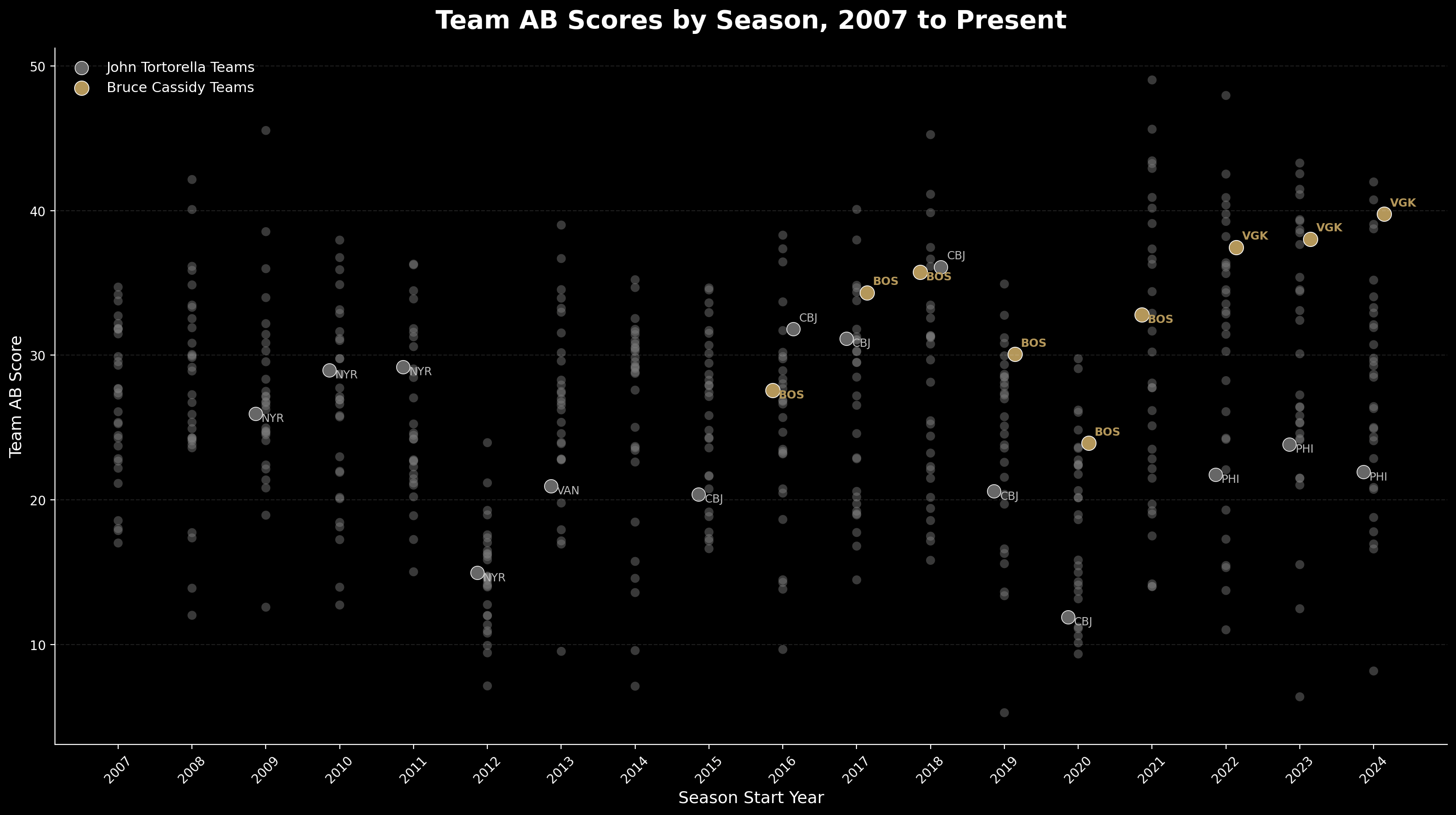
Over the eight seasons illustrated in the graph, Cassidy’s teams recorded the higher Team AB Score in six of them, with an average advantage of 8.48 AB per season. The average gap in either direction was 9.62, meaning that this wasn’t just a marginal difference; Cassidy’s teams were substantially better. Tortorella’s higher finishes in 2016-17 and 2018-19 came at the thinnest margin possible, with Columbus finishing with a 0.34 higher score than the Bruins in 2018. After that season, however, it hasn’t been particularly close; in 2019-20, Cassidy’s teams had a double-digit gap in Team AB points and won a Stanley Cup in 2023 as well.
It’s been established thus far that Cassidy is the obviously better AB Coach than Tortorella, but it’s incredible to see the team left behind in Vegas today. In last week’s article about the Utah Mammoth, I examined the roster outlook of Utah’s players with eleven games remaining in the season (read it here There’s Something Special Going On In Utah, Why The Mammoth Are Here To Stay – hockey free for all.com (HOME OF THE ADVANCED BRACTON)). In it, I made the point that they have the roster ingredients to make noise in a noticeably weaker Western Conference playoff field than in prior years. Unlike Utah, however, unless the Tortorella IMP % metric influences the final 8 games, the Golden Knights have no player with a negative AB Score after 71 games, an incredible achievement that is extremely rare. Below is a graphic illustrating the Golden Knights’ roster construction using AB.

There are a few players, such as recently acquired Nic Dowd and Cole Smith, who are teetering on the line between positive and negative AB contributions. However, the players who have spent the entire season, or most of it, with Bruce Cassidy have had solid campaigns. This further shows the unprecedented situation the Golden Knights have put themselves in, as on paper, they’re the AB favorite to beat the Edmonton Oilers in their likely first-round playoff series if everything held up standings-wise. Prized free-agent signing Mitch Marner has 71 points in 73 games and is 2nd on the team in AB. Mark Stone, although injured during the year, is averaging 1.23 points per game. Pavel Dorofeyev has 34 goals, 2 away from surpassing his career high of 35 set last season. Those outcomes alone are positive for the year; however, the Team AB result at this point is well below what it’s been in all prior years of Golden Knights hockey since 2017. The graphic below illustrates the shift.

When looking at the skaters’ AB Scores in the prior graphic, it’s hard to fathom this rapid decrease in Team AB Score in only a year. Cassidy’s teams were the three highest scoring seasons in franchise history, and faulting him for the sudden plummeting when management failed to address the goaltending situation is going to be a colossal mistake. The Vegas Golden Knights have played four goalies this season: Akira Schmid, Adin Hill, Carter Hart, and Carl Lindbom. None of which have a save percentage higher than .900, and only one (Schmid) has a GAA under 3.00. The fact that they’re STILL in a playoff spot this far into the season, despite having the league’s worst goaltending, is a testament to Cassidy, not an indictment of him. Meanwhile, the goaltender the Golden Knights traded last offseason for a pair of third-round picks, Logan Thompson, has 26 wins with the Washington Capitals, a .913 save percentage, and a 2.43 GAA. Management committed to Adin Hill over Logan Thompson, which could be the mistake that tanked the Golden Knights’ season and their future by scapegoating Cassidy for this ineptitude.
According to John Shannon, John Tortorella’s deal with the Golden Knights is for the remaining 8 games of the regular season and the 2026 Stanley Cup Playoffs. Again, this is an unprecedented, unbelievable move given the timing, and management isn’t giving Tortorella a fair shot to succeed this far in the season without future security. Bruce Cassidy will not be unemployed long, as he will likely be the top candidate for any coaching position opening this summer. The Golden Knights play the Vancouver Canucks at 10 pm EST tonight, and it’s fair to say the attention of the hockey world will be focused on whether or not Vegas’ gamble will pay off.
Leave a Reply