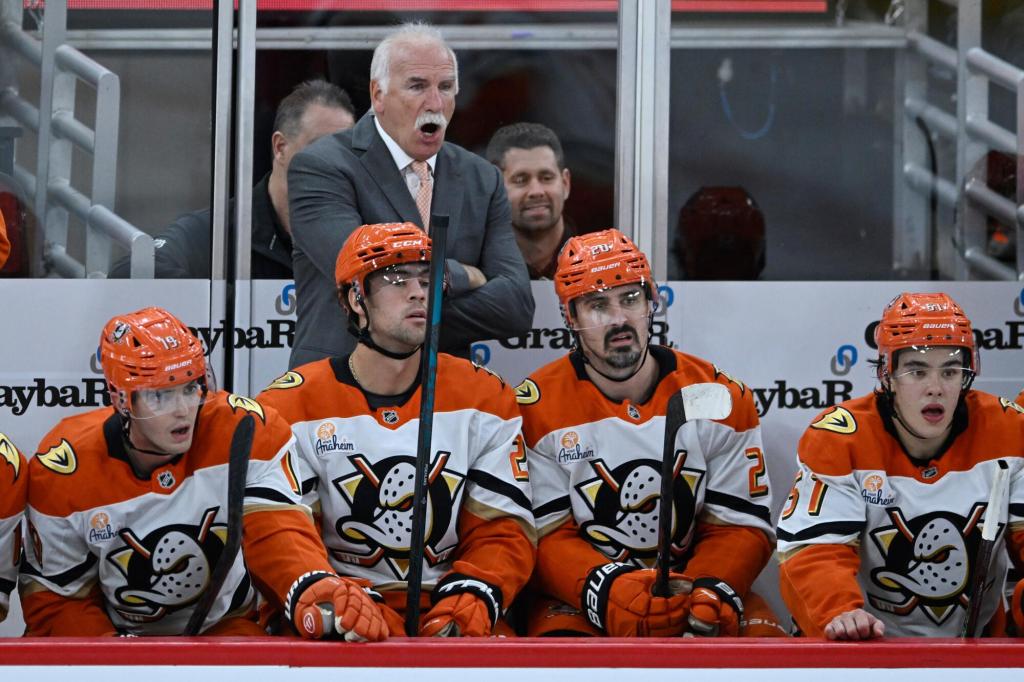
Before their game against the Winnipeg Jets tonight, the Anaheim Ducks hold the third-place spot in the Pacific Division with a record of 31-23-3 (65 points). They trail the Edmonton Oilers by just one point for second place and are five points behind the Vegas Golden Knights for the top seed. With three games in hand on Edmonton and one on Vegas, the Ducks look to be in a prime position to end their eight-year playoff drought and return to postseason contention for the first time since 2018. As we approach the March 6th trade deadline, it’s realistic to expect the Ducks to be buyers and give their team an added boost in their push for the playoffs. There’s plenty of credit to be given for the Ducks’ recent good play, but the hiring of Joel Quenneville was the move that set everything in motion. The study below will analyze how Quenneville is statistically, according to AB_New, the best coach in the NHL (and has been for a long time), and will also discuss another name who could deliver the same kind of immediate impact to another franchise, similar to what Anaheim has experienced behind the bench this season.
Before delving into the coaching impact of Quenneville, it’s important to understand that the 2025-2026 season is the first one in which the AB has changed its methodology. The AB_New score, as discussed in the article The Toronto Maple Leafs Failed Morgan Rielly- And It’s Time for Both Sides to Move On – hockey free for all.com (HOME OF THE ADVANCED BRACTON) here, illustrates the shift towards situational intelligence contributions, aiming to separate player from environment. Because the AB Score formula hasn’t been tampered with in years, to prevent distortion, the Coaching AB formula needed to be adjusted to reflect players’ new scores, which was a significant undertaking for this article. That process involved re-running the historical simulations of the Coaching AB database through the following new, normalized statistics below
- Return IMP% (did a player with the same coach in consecutive years improve their AB score?)
- Advantage% (did a player record a higher score under Coach A than under Coach B the previous year? If so, Coach A gets an advantage point, Coach B gets a disadvantage point)
- Average IMP (the average amount a player’s AB_New increases under a specific coach when using all available players coached by that coach)
- Average Player AB (the average AB_New score a player registered under a given coach)
- Sum of Ranges (the tier-weight distribution system assigning a player’s AB_New score a value between +5 and -5 based on where the score falls on the scale. Aimed to determine which coach produces higher-end AB contributors.
This process produced the new Optimized Coaching AB Score metric, with the formula being 0.25 × norm(Return IMP%) + 0.25 × norm(Advantage%) + 0.20 × norm(IMP / Total Players) + 0.15 × norm(Avg Player AB) + 0.15 × norm(Sum of Ranges). With that being said, Quenneville’s impact can now be fully dissected.
The Anaheim Ducks fired former Head Coach Greg Cronin on April 19th, 2025, leaving a roster filled with young talent and cost-effective veterans looking to take the next step. In the 57 total games played so far, the Ducks have 23 eligible AB players, 17 of whom are considered returning players, 3 rookies with no available prior AB data, and 3 newly acquired players. These include Mikael Granlund of the Dallas Stars, Ryan Poehling of the Philadelphia Flyers, and Chris Kreider of the New York Rangers. The graph below shows the differences in the 2024-25 AB_New scores for the 20 eligible players who have played in each of those seasons up to this point.
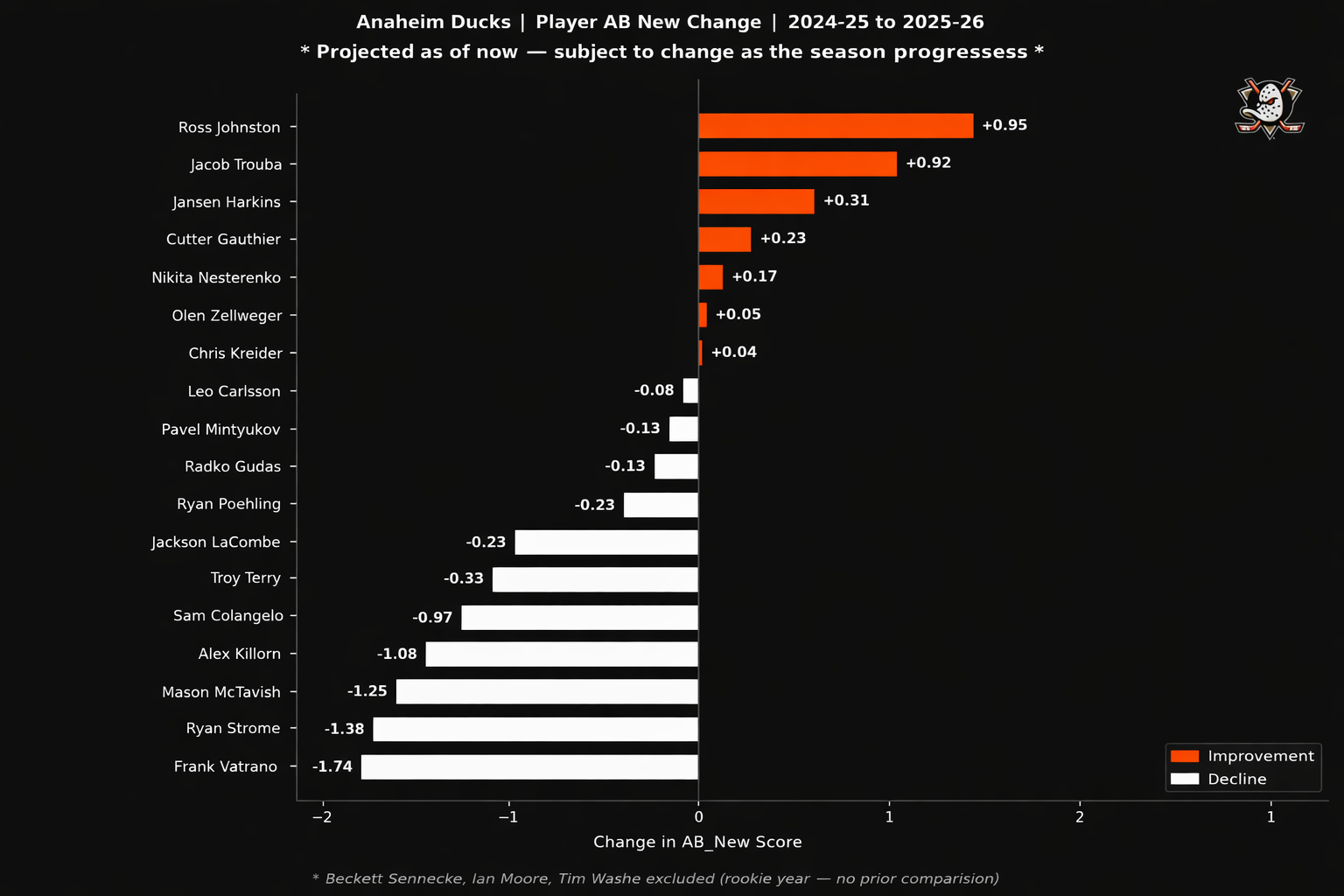
The improvement graph shows that multiple Ducks are benefiting from the coaching change thus far, including franchise cornerstone Cutter Gauthier, who is leading the club in scoring with 50 points in 56 games, including 26 goals and a 17:21 average time on ice. Other standouts include both former New York Rangers Jacob Trouba and Chris Kreider, whom the Ducks were able to acquire as cap casualties at reduced trade costs. It’s also worth noting that the improvement isn’t just limited to the obvious key contributors I mentioned, as depth pieces like Nikita Nesterenko and Jansen Harkins also appear to be benefiting from the move. Although 11 out of 20 players have declined according to the model, it can reasonably be inferred that, with impactful trade-deadline acquisitions and continued good play, several of the 7 players on the verge of improvement will make the flip. This is where the Joel Quenneville difference kicks in: his Advantage percentage is 61%, ranking him 3rd out of 115 eligible coaches in the AB coaches study. Based on the data, if Quenneville delivers at the rate he’s done in the 13 years of AB statistics in the database, Anaheim could record even better numbers in the final two months of the regular season.
Over 57 games, the Ducks’ combined team AB_New is 19.13. For this article, I aimed to estimate, using historical data from the AB datasets and adjusting the projection based on the current standings, the probability that the 2025-26 Anaheim Ducks will make the playoffs under the first year of Quenneville at their pace. To do this, I ran a 10,000-season Monte Carlo simulation starting from Anaheim’s current standings with 25 games remaining. Each simulation generated different remaining game outcomes based on the Ducks’ current win/loss record of 31-23-3. At the same time, each Ducks player’s AB_New score was calculated using the mean and variance within the AB_New framework. The simulation results were aggregated into team-game averages and applied to the 57 already-finished games, yielding fully projected AB_New values for the entire season. The projection model is shown in the graph below.
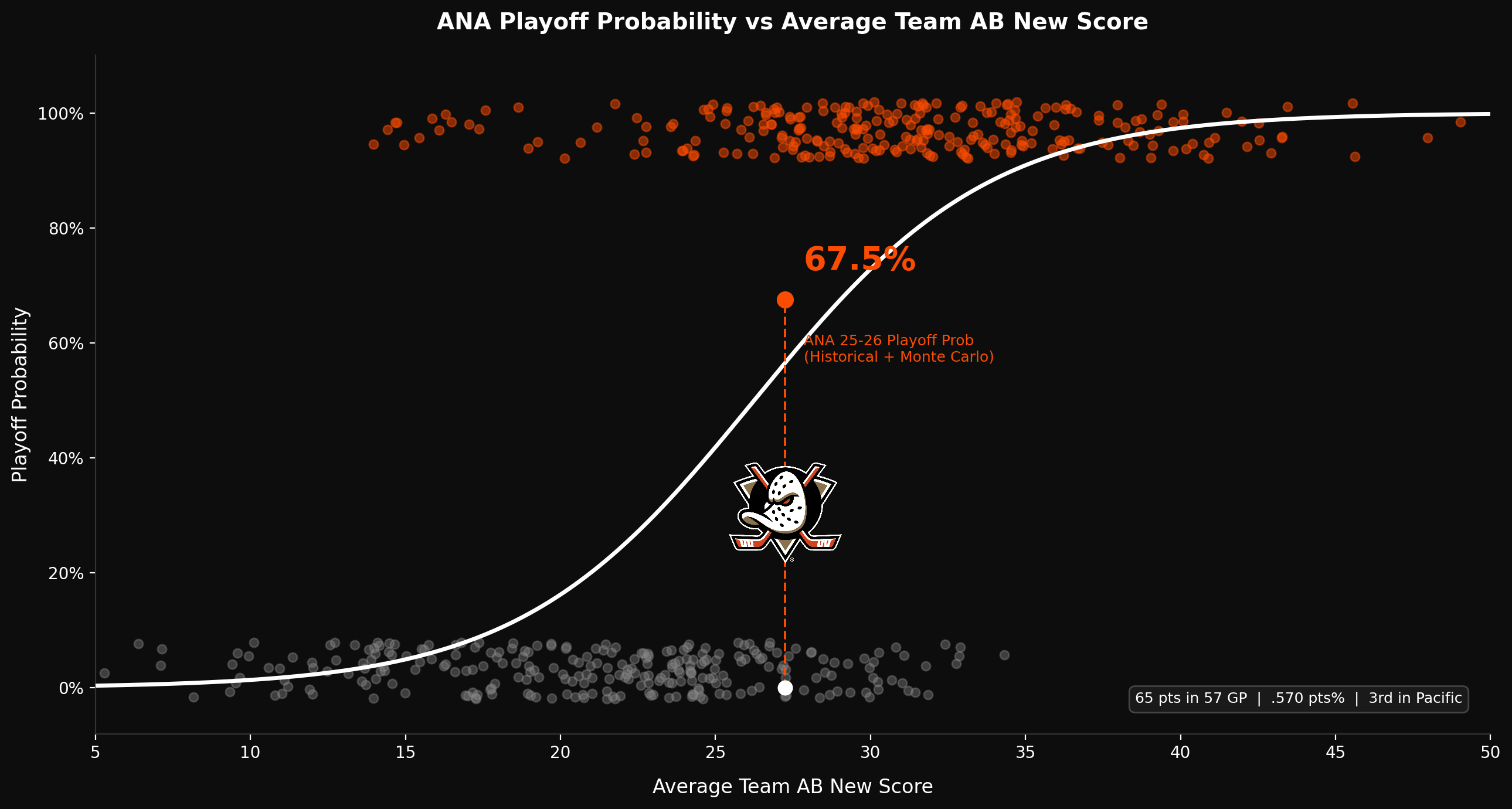
The projection model shows that the Ducks’ final projected team AB_New Score is approximately 27. This supports the theories suggested in the previous paragraphs, which indicate that Quenneville and the Ducks’ player development are on the right track. The model’s projection of nearly an 8-point jump from the 19.13 registered score through 57 games to 27 at the end of the season is banking heavily on Quenneville’s coaching history to deliver the anticipated results through the final stretch. However, based on the results of the Monte Carlo simulations and the historical AB data, the model says the Ducks have a 67.5% chance of reaching the playoffs at their current Western Conference standings and points pace this season. Along with Dan Muse, who’s having a tremendous season leading the Pittsburgh Penguins, Joel Quenneville, to me, should be one of the frontrunners for the Jack Adams trophy for Coach of the Year. The rationale is perfectly illustrated by the model: a “more likely than not” conclusion that, this far into the year, Quenneville breaking the Ducks’ non-playoff qualification streak would be among the more underrated league accomplishments if it happens in the 2025-26 season.
Quenneville’s success in Anaheim is a structural crossing of the AB threshold that is historically required for playoff qualification. However, there’s another coach in the database who is currently unemployed that the model projects would have a similar immediate impact for another NHL team: former Dallas Stars, Vegas Golden Knights, San Jose Sharks, New Jersey Devils, and Florida Panthers Head Coach Peter DeBoer. DeBoer’s record speaks for itself, as he’s coached 1261 career games with a total record of 662-447-152 (.585 points percentage). He led the Sharks and Devils to Stanley Cup Finals appearances, but unfortunately fell both times. Interestingly, the model ranks DeBoer 5th among the 115 coaches in the study from 2007-08 to the present, based on his ability to get results from players, according to AB_New. Below is a graph comparing Quenneville (the #1-ranked coach) to DeBoer (the #5-ranked coach).
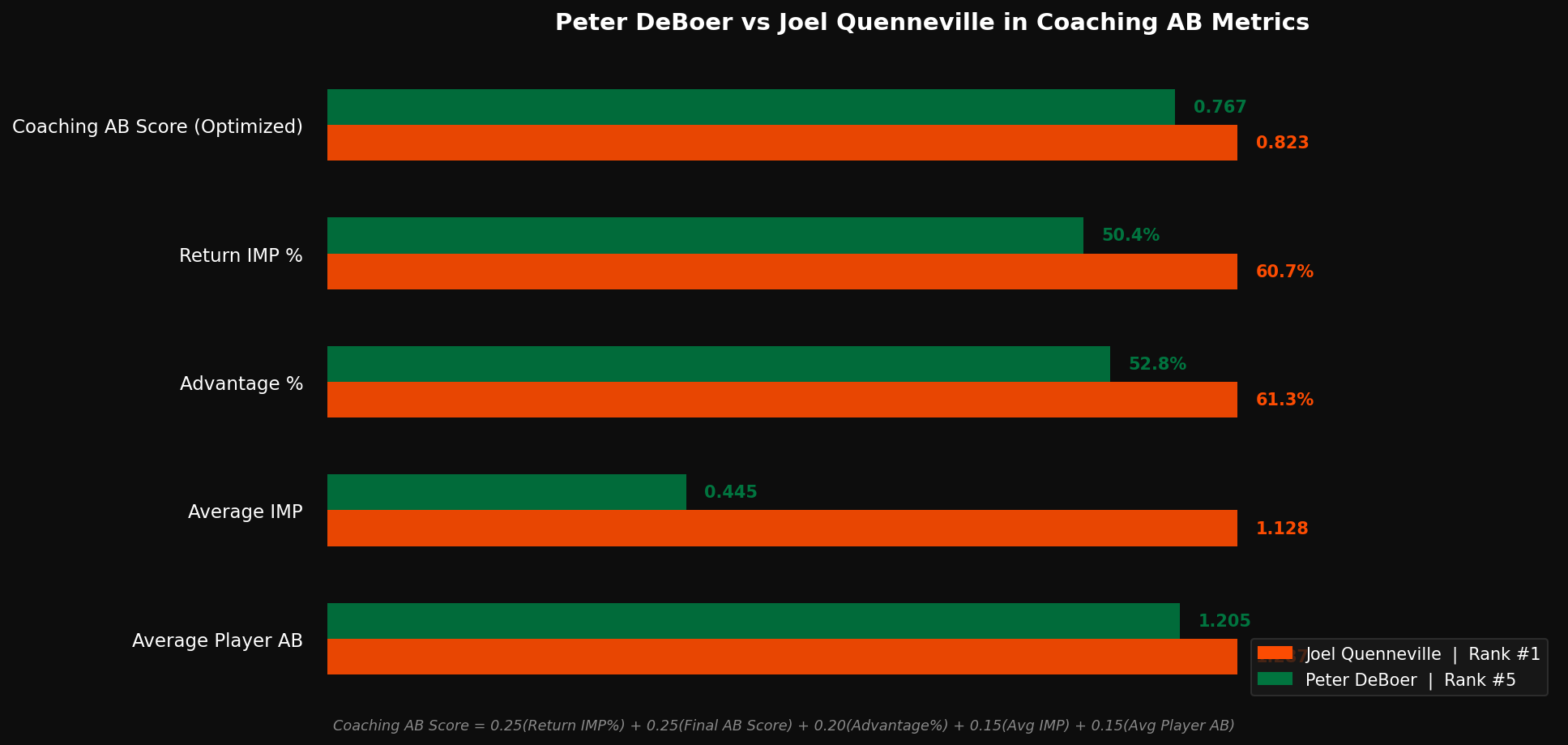
As the graph illustrates, the gap between Quenneville’s 0.823 and DeBoer’s 0.767 is meaningful, but it isn’t categorical. After normalization, both men fall under the elite category of AB coaches, and their systems translate to success on the ice. Peter DeBoer ranks #1 on the list of available coaches in the AB database, and if hired, would be the 5th highest active behind only Quenneville, Tampa Bay’s Jon Cooper, Carolina’s Rod Brind’Amour, and Vegas’ Bruce Cassidy. DeBoer’s metrics reveal among the highest Advantage Percentages (crucial for a new head coach hire), and Return IMP Percentages of all coaches in the study. The data shows that DeBoer’s teams consistently were among the best AB performers, and that success can be replicated anywhere (given that he’s coached five different teams during the AB-era). Without question, the teams that will be searching for coaches this offseason should all have DeBoer at the top of their lists, as he’s the only available coach in the database who is capable of doing anything like what Quenneville has done in Anaheim in a few short months. Personally, I believe that if the Toronto Maple Leafs fire Craig Berube after possibly missing the playoffs this season, DeBoer would be a great choice to help save 2027 from facing a similar outcome.
Anaheim’s position in the standings is easy to see, but to me, it matters more about why it’s happening. Joel Quenneville didn’t just step into a promising rebuild and is benefiting from its natural maturation. He is a proven winner who’s systematically ahead of his peers. Both the old coaching AB score, in addition to the recalibrated one, identified him as the league’s best, and he’s proving it with Anaheim’s resurgence. If the model’s elite coaches remain consistent, then Peter DeBoer won’t have to wait much longer to be behind an NHL bench once again. Whichever organization is as smart as the Ducks were when they hired Joel Quenneville is poised to reap similar rewards with DeBoer. It will be interesting to see how the rest of the season unfolds.
 hockey free for all.com (HOME OF THE ADVANCED BRACTON)
Leave a comment