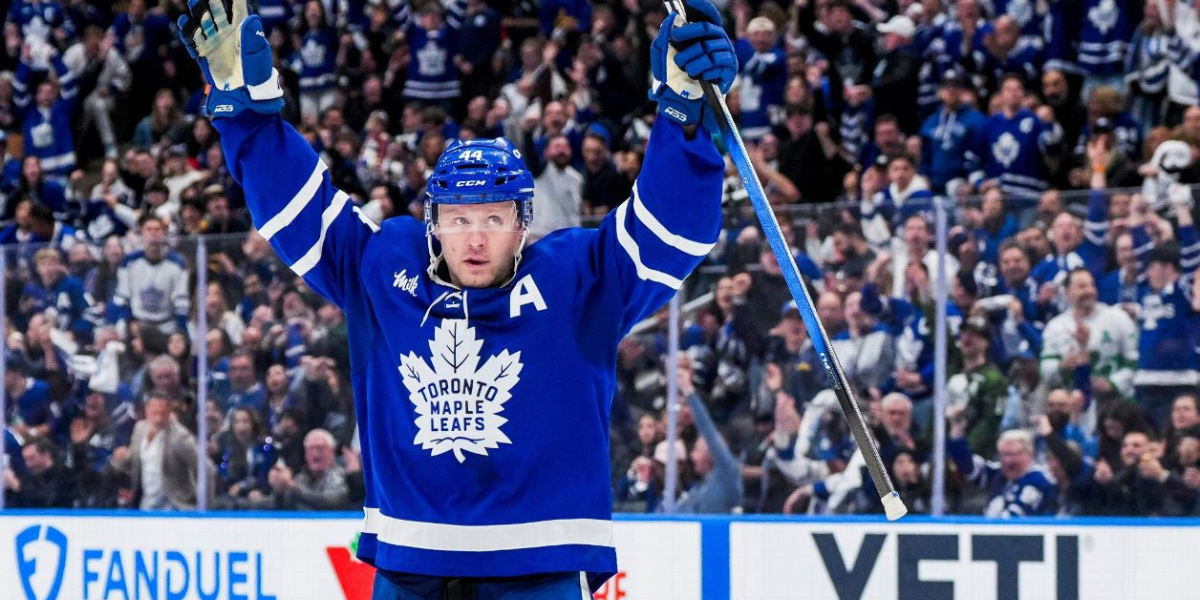
The Toronto Maple Leafs return from the Olympic break tomorrow night at 7:30 pm to face the Atlantic Division-leading Tampa Bay Lightning. Currently six points behind their rival, the Boston Bruins, for the final wildcard spot in the Eastern Conference, the Leafs’ management team faces major questions about the club’s direction for the rest of the season, with the trade deadline only 10 days away. One of the decisions that fans and media aren’t discussing enough is what to do about franchise icon Morgan Rielly, a staple of the Leafs’ blueline since his rookie year in 2013-14. Rielly has been a polarizing topic of Leafs Nation for the better part of the last few seasons, and his on-ice production is continuing to decline halfway through his age-31 season. The following analysis will dissect the case of Morgan Rielly in depth, illustrate why a divorce feels inevitable, and why it could benefit both the team and the player.
Before beginning, it’s important to note that the hiatus from posting articles from the 2025-2026 season has been the result of an intense formula evaluation process of the AB Score itself. Upon entering into a Ph.D. program and taking the advice of academics and sport leaders alike, it was clear that the underlying methodology behind the AB Score and hockeyfreeforall.com family of metrics needed some tweaks and improvements. The latest iteration of the AB Score, called AB_New, will serve as the basis for the insights in the following article. The characteristics of a “good” AB player and the overarching philosophy haven’t changed, as those are fundamental to the work of this site and the research published. The new version does a better job of separating environmental factors from overall contribution and incorporates more proprietary information in the final score. However, the basic premise remains the same: higher values indicate more value and better impact, while lower values indicate negative contributors. The biggest difference between the two is that “negative” contributors may no longer have physical negative AB scores, as the formula change produces a new individual score.
If you’ve read any of the previous work on this site, you’ll notice numbers in this article seem much higher than in years past, and that’s a direct result of this necessary formula change. The results of this change yielded a 0.87 correlation between AB_New and wins during an NHL season over the last eighteen years, as well as a 0.90 correlation between AB_New and points in the standings during the same time span, increasing AB’s effectiveness from the former 0.71 and 0.75 correlations, respectively. For more information about the philosophy of the AB Score and what characteristics are appreciated under this framework, please read the article, The Intersection of Data Analytics and Managerial Philosophy in Professional Hockey – hockey free for all.com (HOME OF THE ADVANCED BRACTON). With that being said, let’s talk about Morgan Rielly.
Overall, the updated AB_New data shows that Morgan Rielly has been a great Toronto Maple Leaf. He’s had a career that spans 927 NHL games, all with the blue and white. Barring any serious injuries, will likely surpass the 1,000-game threshold, a mark that only 412 players in the history of hockey have ever accomplished. The data suggests that he’s had a solid, occasionally excellent career, but has never been the true #1 defenseman like the Cale Makars and Quinn Hughes of the world. The graph below shows his fluctuation in AB_New score over the course of his career, relative to the replacement level (calculated by finding the average of all AB_New scores of defensemen who played over 20 games in a given season).

As shown above, Rielly peaked in 2018-2019 and again in 2021-2022. These seasons saw him finish 5th and 11th in Norris Trophy voting, respectively, demonstrating that Rielly established himself among the best at his position, but not quite at the top tier. However, the graph shows several concerning conclusions. First, Rielly has had a wildly inconsistent, yet still above-replacement-level, career. Second, he is in the post-30 decline that affects many players. When calculating his AB_New for the 57 games played so far this regular season, the result is a 1.06, which is his lowest recorded total since 2016 if it holds. Outside of those 2018-19 and 2021-22 seasons, his numbers profile him as a strong second-pairing defenseman rather than a true #1.
The graph below highlights the gap between Rielly’s performance and his role. He isn’t being paid like a #1 defenseman. In fact, at $7.5 million, his contract is fairly fitting for the role he’s asked to play, as well as what he should be playing. Rielly’s contract closely aligns with players who support a true No. 1 defenseman, not someone expected to carry an entire defensive unit, which he has been doing for the last decade. By the arbitration analyzer tool (see referenced article from the second paragraph), Rielly isn’t overpaid, and has provided exactly fair value over the course of his career. The issue between Rielly and the Leafs is structural: the team has failed to trade for, sign, or draft and develop a true #1 defenseman during Rielly’s tenure. Due to a lack of alternatives, he became the Leafs’ top-minute eater and de facto defensive cornerstone, even though that isn’t truly who he is for most of his career. He’s been paid like a #2 and deployed as a #1, which has been a detriment to him and the club for years. When examining Rielly’s partner list during this time span, the issue becomes even clearer.

Based on reading through old articles and game sheets, the following players were recorded as defense partners for Morgan Rielly at various points during his tenure with the Leafs.
- Nikita Zaitsev
- Matt Hunwick
- Roman Polak
- T.J. Brennan
- Frank Corrado
- Luke Schenn
- Ron Hainsey
- Jake Gardiner
- T.J. Brodie
- Timothy Liljegren
- Rasmus Sandin
- Jake Muzzin
- Oliver Ekman-Larsson
- Phillippe Myers
- Chris Tanev
- Jake McCabe
- Jani Hakanpaa
- Simon Benoit
- Conor Timmins
- Brandon Carlo
This list isn’t the partner history of a franchise defenseman being supported by a strong organizational philosophy at defense. It’s the history of a team that’s constantly trying to find plug-and-play solutions to a problem that remains unsolved. The graph below shows the trajectory of Rielly’s noted defense partners relative to their usage and their AB_New.

The insights here are disturbing, as very few of these players were high-impact defensemen or significantly older and past their prime when acquired by the Leafs, such as Chris Tanev and Oliver Ekman-Larsson. Jake Gardiner actually posted the best recorded AB_New scores of all of Rielly’s partners, and he was never considered to be a defensive stalwart. Most of the names on this list clustered around league average or fell below replacement-level, as the graph illustrates. We’ve established that Rielly hasn’t been producing as his role suggested he should have the past several years, yet the organization pairs him with players who weren’t needle movers either.

The graph above reinforces this point. When we look at the AB_New values of Morgan Rielly’s defense partners and compare them to all defensemen in the eighteen-year study who played over 20 games, the partner curve falls almost exactly on league average. This isn’t a criticism of the nineteen players listed as former or current Morgan Rielly defense partners. In fact, many of them were reliable, competent professional hockey players with the Leafs, but needed to play a role that didn’t fit their skillsets, or Rielly’s. This is incredibly important, as top defensive pairings are supposed to either be elite with elite or elite with an elite complement. In the modern era, it’s fair to say that the Leafs have never had either configuration. Instead, they forced good, above-replacement, but not elite players, into elite roles against better competition. This is perhaps why Rielly himself is -17 in the year so far in 2025-26, as he plays unsuccessfully against the opposition’s best players despite needing a much more structured environment to utilize his skillset at this current time.
The graphs and list also present a much scarier conclusion for the Leafs as a franchise, as only four of those nineteen names were drafted by the Leafs, and one of them, Luke Schenn, was reacquired and didn’t play with Rielly until much later in his career. The others, Frank Corrado, Rasmus Sandin, and Timothy Liljegren, were some of the lower performers relative to AB_New. Liljegren was traded to the San Jose Sharks in October of 2024. He currently plays alongside Mario Ferraro on the Sharks’ top defense pairing, according to DailyFaceoff, averaging over 20 minutes per game in 42 games so far this year. Rasmus Sandin was also traded to the Washington Capitals at the 2023 trade deadline and has been a fine player for the Caps ever since. Those two were unquestionably the best defensemen the Leafs drafted during Rielly’s tenure, and both no longer being with the team says a lot about the development of the position at the club. Since the Leafs drafted Morgan Rielly in 2012, the list below includes the other defensemen the Leafs invested draft capital in during that period.
- Round 2-Matt Finn (0 NHL games)
- Round 7- Viktor Loov (0 NHL games)
- Round 3- Rinat Valiev (12 NHL games)
- Round 2- Travis Dermott (348 NHL games)
- Round 3- Andrew Nielsen (0 NHL games)
- Round 4- Jesper Lindgren (0 NHL games)
- Round 6- Stephen Desrocher (0 NHL games)
- Round 3- J.D. Greenway (0 NHL games)
- Round 4- Keaton Middleton (47 NHL games)
- Round 6- Nicolas Mattinen (0 NHL games)
- Round 1- Timothy Liljegren (306 NHL games)
- Round 1- Rasmus Sandin (361 NHL games)
- Round 2- Sean Durzi (278 NHL games)
- Round 4- Mac Hollowell (6 NHL games)
- Round 5- Filip Kral (2 NHL games)
- Round 5- Michael Koster (0 NHL games)
- Round 7- Kalle Loponen (0 NHL games)
- Round 3- Topi Niemela (0 NHL games)
- Round 4- William Villeneuve (0 NHL games)
- Round 6- Axel Rindell (0 NHL games)
- Round 7- John Fusco (0 NHL games)
- Round 6- Noah Chadwick (0 NHL games)
- Round 1- Ben Danford (0 NHL games)
- Round 4- Victor Johansson (0 NHL games)
- Round 7- Matt Lahey (0 NHL games)
- Round 7- Nathan Mayes (0 NHL games)
- Round 6- Ryan Fellinger (0 NHL games)
In fairness to Chadwick and below, they were drafted by the Leafs within the last three years, so it’s reasonable to assume some of them could reach the NHL and be meaningful contributors. However, the purpose was to show that the Leafs have spent three first-round picks, three second-round picks, four third-round picks, five fourth-round picks, two fifth-round picks, five sixth-round picks, and five seventh-round picks on defensemen, none of whom, except for recently drafted Ben Danford, remain in the organization. Like Liljegren and Sandin, Sean Durzi was also traded before he could play a game with the Leafs, as the Leafs dealt him for Jake Muzzin on January 28th, 2019, in another attempt to find a partner who could work with Morgan Rielly.
It is clear that Morgan Rielly is still a capable NHL defenseman. His offensive output of 7 goals and 24 assists for 31 points put him 28th in defenseman scoring so far in 2025-26. Rielly has also earned the narrative as a postseason performer, registering 47 points in his 70 career playoff games. He actually holds the Maple Leafs franchise record for most playoff goals by a defenseman with 15. However, the Leafs have played almost an entire season without Rielly since drafting him in 2012, posting a 48-21-7 record (111-point pace) in that span. A team doesn’t record that type of winning percentage without its supposed franchise defenseman unless the system is capable of functioning without him. It can be said that the Leafs played a much more structured, simpler game without Rielly, as the pressures of stepping into higher roles diminished and less was expected of the rest of the group in his absence. While one could argue that, historically, Morgan Rielly isn’t the problem in Toronto, the research suggests that he isn’t the solution either. The Leafs never built a pipeline to stabilize the defense position over the last fourteen seasons, never structured Rielly the way he needed to thrive consistently, and have unfairly asked him to be something he’s not. The trends and findings in this article illustrate that Rielly is in decline at age-31, but his contract, especially in today’s rising salary cap world, presents an opportunity for the Leafs to start over on defense and begin to realign the position group as it should be. Although Rielly has a no-movement clause, the conversation should be had with him 10 days out from the trade deadline about a potential change of scenery.
Morgan Rielly has been a great Maple Leaf, perhaps one of the franchise’s greatest defensemen of all time. But the reality is that in today’s NHL, he has an opportunity to thrive elsewhere, and his advisory team should take that into consideration if Leafs management approaches them with a trade. This situation isn’t about disrespecting a franchise legend; it’s about speeding up the process of fixing a decade of structural mistakes in how the Toronto Maple Leafs evaluate and use the defense position, while also doing right by a player who’s given his all to the team and the city during his time in the sweater.
Leave a Reply