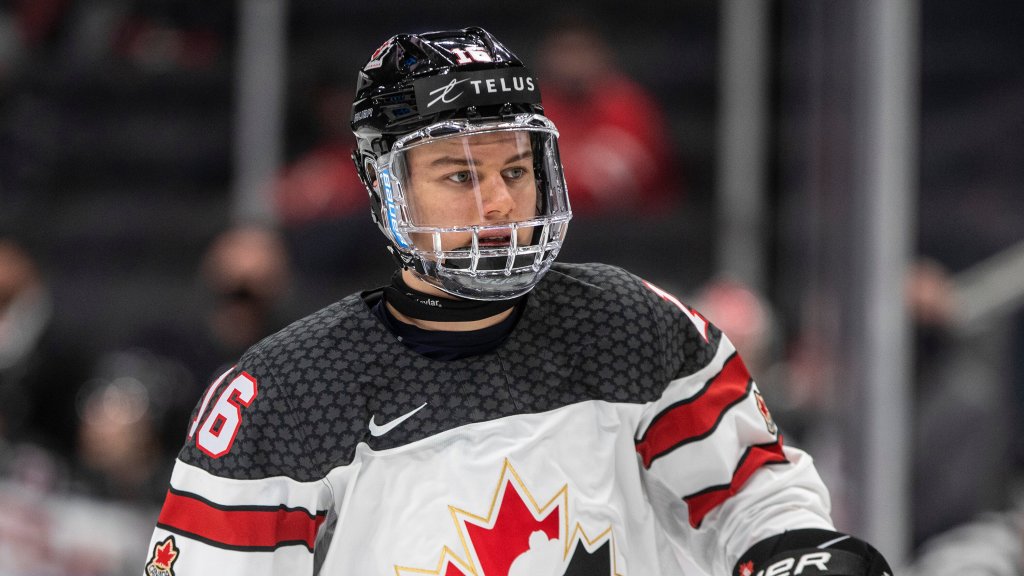
Last month, the Chicago Blackhawks won the right to select the NHL’s next superstar prospect, Connor Bedard. Expectations are understandably sky-high for Bedard to have an immediate NHL impact, as he absolutely dominated the Western Hockey League throughout his early teenage years. In his first season (2020-21), as a fifteen-year-old, Bedard recorded twenty-eight points in fifteen games, including twelve goals in that span. He became the youngest player ever to score fifty goals in a WHL season, and the third sixteen-year-old ever to record a hundred-point season in the league. On top of that, he registered one-hundred-forty-three points in fifty-seven games during his draft-eligible season in 2022-23, in addition to twenty points in just seven playoff games. Bedard has had an outstanding international career so far as well, as he won gold with Team Canada at the 2022 and 2023 World Junior Championships. After recording the most points in a single World Juniors tournament in 2023, Bedard also became the all-time leader in points for Team Canada at the WJC, which is highly impressive given the illustrious history of the program. The hype is even present in the world of AB, as Bedard officially recorded a higher pre-NHL TAB score at +8 than former 1st overall picks Steven Stamkos (+7.75), Auston Matthews (+5.17), John Tavares (+4.40), and Nico Hischier (+3.17). There is no shortage of accolades when it comes to Bedard, and he’s only ten days away from likely becoming the first overall pick in the 2023 NHL Draft. Over the past several weeks, I have been studying the effects the #1 overall pick has had on their respective franchises since the beginning of the AB era for the purpose of formulating some realistic expectations for Connor Bedard’s rookie season with the Blackhawks in 2023-24. This article will analyze trends of the last fifteen first overall picks, as well as discuss the outlook of the Chicago Blackhawks organization with Bedard. This will include a detailed analysis of internal and external options for potential linemates and supporting cast, as the club will need to surround Bedard with talent this offseason.
Immediate Impact of #1 Overall Picks in AB Era
Having the first overall pick does not guarantee imminent success, nor is it a guarantee that the prospect selected will develop into the star player they’re expected to be (Nail Yakupov, Alexis Lafrenière, Juraj Slafkovsky?). However, the table below suggests that following the addition of a #1 pick caliber player to a respective lineup, there is some quantifiable immediate impact present in terms of AB.
Previous 1st overall Picks Immediate Impact if any?
| Player Name | Team | Year Drafted | AB Change Year 1 | Playoffs? | Years to Playoffs | Calder? |
| Steven Stamkos | Tampa Bay Lightning | 2008 | -21.37 | No | 3 | No |
| John Tavares | New York Islanders | 2009 | +54.95 | No | 4 | No |
| Taylor Hall | Edmonton Oilers | 2010 | -0.49 | No | 7 | No |
| Ryan Nugent-Hopkins | Edmonton Oilers | 2011 | +25.83 | No | 6 | No |
| Nail Yakupov | Edmonton Oilers | 2012 | +21.55 | No | 5 | No |
| Nathan MacKinnon | Colorado Avalanche | 2013 | +70.97 | Yes | 0 | Yes |
| Aaron Ekblad | Florida Panthers | 2014 | +25.16 | No | 2 | Yes |
| Connor McDavid | Edmonton Oilers | 2015 | +26.37 | No | 2 | No |
| Auston Matthews | Toronto Maple Leafs | 2016 | +48.70 | Yes | 0 | Yes |
| Nico Hischier | New Jersey Devils | 2017 | +60.64 | Yes | 0 | No |
| Rasmus Dahlin | Buffalo Sabres | 2018 | +0.35 | No | 5+ | No |
| Jack Hughes | New Jersey Devils | 2019 | +20.41 | No | 4 | No |
| Alexis Lafrenière | New York Rangers | 2020 | +14.78 | No | 2 | No |
| Owen Power | Buffalo Sabres | 2021 | +50.64 | No | 1+ | No |
| Juraj Slafkovsky | Montreal Canadiens | 2022 | +18.97 | No | 1+ | No |
Although the AB era began during the 2007-08 NHL season, including 2007 1st overall pick Patrick Kane in this study would not be beneficial, as the proper AB data from the 06-07 season is unavailable. The biggest takeaway from this table is in column four, as it depicts the change in overall team AB score after a #1 pick’s rookie season in the NHL. Of the fifteen teams in this study, thirteen of them recorded higher team AB scores than the previous season without their #1 pick prospect. This includes an average improvement of +27.83 team AB points, which I consider a significant change. However, only three of these teams actually qualified for the playoffs in their #1 pick’s rookie season (20%), as these teams were Nathan MacKinnon’s Colorado Avalanche in 2013-14, Auston Matthews’ 2016-17 Toronto Maple Leafs, and Nico Hischier’s 2017-18 New Jersey Devils. In fact, Matthews and MacKinnon were two of only three #1 overall picks in the last fifteen seasons to win the Calder Trophy during their rookie season, Aaron Ekblad of the Florida Panthers being the third. Excluding Juraj Slafkovsky (MTL), Rasmus Dahlin (BUF), and Owen Power (BUF), as their teams have yet to make the postseason since drafting them 1st overall, it has taken an average of 2.91 years (3 rounded up) for a team selecting 1st overall to qualify for the Stanley Cup Playoffs in the AB era. It’s even crazier to consider that only two of these #1 pick players are Stanley Cup champions, as Steven Stamkos’ Tampa Bay Lightning won in 2019-20 and 2020-21, as well as Nathan MacKinnon’s Colorado Avalanche in 2021-22.
Next, I thought it would be interesting to compare every 1st overall pick’s individual AB performances during their rookie season and determine how long each of them took to record a positive season (if ever). The table below illustrates these findings.
1st Overall Pick Individual AB Scores
| Player Name | 1st Year AB Score | Years to 1st Positive Score |
| Steven Stamkos | -1.84 | 3 |
| John Tavares | -4.15 | 3 |
| Taylor Hall | -0.44 | 3 |
| Ryan Nugent-Hopkins | -0.09 | 2 |
| Nail Yakupov | -1.33 | N/A |
| Nathan MacKinnon | +7.04 | 0 |
| Aaron Ekblad | +2.47 | 0 |
| Connor McDavid | +1.35 | 0 |
| Auston Matthews | +2.89 | 0 |
| Nico Hischier | +5.44 | 0 |
| Rasmus Dahlin | -5.18 | 5 |
| Jack Hughes | -6.20 | 4 |
| Alexis Lafrenière | -1.69 | 2 |
| Owen Power | +1.25 | 0 |
| Juraj Slafkovsky | -4.84 | N/A |
Based on the information above, I determined it took an average of 1.7 years for a 1st overall pick to record a positive individual AB score. This excludes 2012 1st overall pick, Nail Yakupov, and 2022 1st overall pick, Juraj Slafkovsky, who have yet to record a positive individual AB score. The average rookie season AB score of a 1st overall pick in the AB era is -0.35. In fact, only six 1st overall picks in the AB era were positive AB players during their rookie seasons, those six being Nathan MacKinnon, Aaron Ekblad, Connor McDavid, Auston Matthews, Nico Hischier, and Owen Power. These players already had a solid supporting cast upon their arrival, which is going to be critical for the Blackhawks to address this offseason, as surrounding their franchise prospect with talent should be the biggest priority. The next section of this article will suggest there are some intriguing options in what is considered to be a weak 2023 free agency class by many.
Potential Linemates and Supporting Cast (External Options)
Drafting a player like Connor Bedard certainly makes the Chicago Blackhawks a more attractive free-agency destination for the foreseeable future. The opportunities for players to sign short-term, financially lucrative contracts exist due to the wealth of cap space the Blackhawks currently have. The team only has one forward (Andreas Athanasiou at $4.25 million until 2025-26), and two defensemen (Seth Jones at $9.5 million until 2029-30 and Connor Murphy $4.4 million until 2026-27), signed beyond the 2023-24 season. On top of the rare cap flexibility in today’s NHL, the Blackhawks also have an abundance of draft capital that signals an influx of young talent entering the organization at a premier time. The salary cap is set to increase in the near future, and with Bedard, 2020 1st round pick Lukas Reichel, and 2022 1st round picks Kevin Korchinski and Frank Nazar under ELC’s for the next several years, the Blackhawks have a huge opportunity to weaponize their cap space in order to acquire solid players and assets. This is a similar strategy that the Stanley Cup Champion Vegas Golden Knights and the expansion Seattle Kraken used to accelerate their progress, as teams paid the expansion clubs assets in exchange for ridding them of bad contracts. It’ll be interesting to see if the Blackhawks adopt a similar strategy in the trade markets, however, the names below are ones that I think the team should consider adding in free agency that could ease Bedard’s transition to the league.
Max Pacioretty
Before his multiple ACL injuries, Max Pacioretty was one of the most consistent, exciting players in the league. Even with injury-filled seasons over the past several seasons, Pacioretty still recorded sixty-six points in seventy-one games in 2019-20, fifty-one points in forty-eight games in 2020-21, thirty-seven points in thirty-nine games in 2021-22, and only three points in five games in 2022-23. Max Pacioretty is a 0.75ppg scorer and a 0.96ppg scorer in the last four seasons. In the fourteen years of individual AB data that I have on Pacioretty, he has a career AB score of +1.58, including a +3.17 average score during that four-season sample size previously mentioned. He’s recorded positive AB scores in ten of those fourteen seasons. Given that he just suffered his second Achilles injury in less than a season, it’s a real thought that we may have seen the last of Pacioretty in the NHL. However, given the fact that he’s obviously not going to be a $7 million dollar player anymore, the Blackhawks should explore offering him a short-term (1-2 years), $2 million AAV contract and put him on Bedard’s wing. Of all the teams in the NHL, I believe the Blackhawks have the least to lose in signing Pacioretty, as they can clearly afford it given their salary cap situation. If Pacioretty is open to playing with Bedard as opposed to retirement, the Blackhawks would be a very interesting fit.
Alex Killorn
After winning back-to-back Stanley Cups with the Tampa Bay Lightning in 2019-20 and 2020-21, Alex Killorn has a chance to follow in his former teammate Ondrej Palat’s footsteps by earning a financially lucrative deal on a young team where he can spend the rest of his career. Why not reunite with another former teammate from the Cup team in Tyler Johnson with Chicago? Like Pacioretty, Killorn has also been a historically good AB player, as he has a +1.84 career AB score in eleven seasons of data (including a +2.04 average score over the last four seasons). Killorn has recorded a positive individual AB score in eight of those eleven seasons and was critical in the Tampa Bay Lightning’s playoff success as previously mentioned. His regular season point contributions were solid, as he had forty-nine points in sixty-eight games in 2019-20, thirty-three points in fifty-six games in 2020-21, fifty-nine points in eighty-two games in 2021-22, and sixty-four points in eighty-two games in 2022-23. The hockeyfreeforall.com arbitration analyzer tool suggests that a comparable player to Alex Killorn is Mats Zuccarello of the Minnesota Wild, who is currently in the final year of a five-year, thirty-million-dollar deal with the team ($6 million AAV). Perhaps the same five-year, thirty-million-dollar deal Ondrej Palat signed last summer with the New Jersey Devils is another comparable here as well. It would certainly be interesting to see the Blackhawks offer Killorn a higher AAV for less term, as again, their cap situation is spectacular.
Tomas Tatar
Of the three names I mentioned, Tomas Tatar is the one I find the least likely to sign with the Chicago Blackhawks this free agency period. However, I believe there is a fit here, as Tatar is a flexible player who found ways to play up and down the Devils’ lineup this season. Tatar spent time with all of the Devils’ best players throughout the season and was one of the better players on a solid third line on many occasions. Tatar had sixty-one points in sixty-eight games in 2019-20, thirty-points in fifty games in 2020-21, thirty points in seventy-six games in 2021-22, and forty-eight points in eighty-two games in 2022-23 (including a +41 +/- rating this season as well). Like Killorn and Pacioretty, Tatar has also been a consistently positive AB player throughout his career, as he has a +1.27 career AB score over eleven seasons. In those eleven seasons, Tatar has recorded a positive AB score in eight of them, including a +1.23 average score over the last four seasons. The hockeyfreeforall.com arbitration analyzer tool suggests that a comparable player to Tomas Tatar is Los Angeles Kings forward Viktor Arvidsson, who is currently in the final year of a seven-year, $4.25 million AAV contract ($29.75 million total dollars). It’s worth speculating that the chance to play with a player of Bedard’s caliber could help lure a player like Tatar to Chicago; however, there are likely to be many other suitors for his services on July 1st, as I consider him to be one of the better players available in this free agency class.
Potential Linemates and Supporting Cast (Internal Options)
I believe the Chicago Blackhawks have some of the pieces in place to build a competitive roster around Connor Bedard internally, as some of the possibilities I’ll discuss in greater detail below are players I think will have a big impact on the Blackhawks’ success next season. However, it’s worth mentioning that the team has a second first-round pick available to them in this year’s draft, in addition to four second-round picks, which could allow them to trade up in the draft for a second NHL-ready player. The Blackhawks will definitely be one of the league’s most interesting teams at the Nashville draft, but for now, let’s examine some already in-house possibilities to make up the supporting cast for Connor Bedard in 2023-24.
Lukas Reichel
I briefly mentioned Reichel before as someone who has tremendous upside, as the 2020 17th overall pick has dominated the American Hockey League with the Rockford IceHogs. During his 2021-22 AHL season, Reichel scored twenty-one goals with fifty-seven total points in fifty-six games, as well as another twenty-goal, fifty-one total point season in fifty-five games in 2022-23. Reichel even played in twenty-three NHL games during the 2022-23 season, in which he recorded seven goals with fifteen total points. During his brief stint with the Blackhawks, Reichel posted a -2.38 individual AB score, which was actually the fourth-highest score on the club amongst players who played over twenty games. Reichel also clearly made an impact in the eyes of Blackhawks head coach Luke Richardson, as his 16.22 minutes of average TOI per game was among the highest of any Blackhawks forward last season, trailing only Captain Jonathan Toews (17.43), Philipp Kurashev (17.25), Taylor Raddysh (16.34), and Tyler Johnson (16.34). It’ll be interesting to see if the twenty-one-year-old Reichel can establish himself in a permanent top-six role for the Blackhawks this season, as it would certainly be fun to watch Reichel and Bedard grow and develop together.
Tyler Johnson
Johnson is a player that was mentioned several times throughout this article as someone whose championship pedigree and playoff experience could benefit a young prospect like Bedard. Johnson has always been a good AB player throughout his career, as he has a career AB score of +1.23 over eleven seasons. He recorded positive AB scores in seven of those eleven seasons, including a -1.77 score over the last four years. In those last four years, Johnson registered thirty-one points in sixty-five games in 2019-20, twenty-two points in fifty-five games in 2020-21, seven points in twenty-six games in 2021-22, and thirty-two points in fifty-six games in 2022-23. With Johnson playing top-six minutes for Luke Richardson’s club last season, it is reasonable to infer that without significant changes, Johnson will be on one of Chicago’s top two lines, and it would be interesting to see how he performs with Bedard if possible.
Conclusion
The average number of total points recorded during the AB era by a 1st overall pick is about forty-two (41.8 to be exact), a number that likely would have been higher if Connor McDavid continued at his point-per-game pace prior to his rookie year injury during the 2015-16 season. In fact, Auston Matthews’ sixty-nine points in 2016-17 were the most by a 1st overall pick in the last fifteen years. While I believe Luke Richardson and the rest of the Blackhawks coaching staff will put him in every position to succeed from the beginning, I think a realistic expectation for Bedard based on my numbers this season is sixty points. So, what does all this mean for the Blackhawks? For starters, I think it’s very unlikely Bedard leads them to a playoff spot in 2023-24 but expecting an overall team AB score increase, a Calder Trophy nomination (likely win), an individual AB score near -0.35, and sixty total points doesn’t seem like a ridiculous ask. There are obviously going to be roadblocks along the way. However, if the foundation of a supporting cast is established and improved during this offseason, I see no reason why the Blackhawks can’t at least be a team that is difficult to play against or one that is competitive every night. With that being said, I do believe it’s going to take most or all of Bedard’s entry-level contract years for the Blackhawks to make the playoffs based on my data, as the team clearly still has significant work to do on the roster construction front. Despite this, it is definitely an exciting time for the Chicago Blackhawks organization and their fans, as the dream of Connor Bedard playing for one of the most storied franchises in all of professional sports will likely become reality in just ten short days. Much more to come.
 hockey free for all.com (HOME OF THE ADVANCED BRACTON)
Leave a comment